

Zcash ETF vs Direct ZEC Investing: Which Strategy Makes Sense?


This blog post will cover:
- Introduction
- Why Zcash Matters
- The Importance of Zcash Grayscale Case
- Zcash ETF: What It Is and How It Works
- What Is Direct ZEC Crypto Investing
- Zcash ETF vs Direct ZEC
- Practical Differences at a Glance
- Which Strategy Fits Whom?
- Risks, Regulatory Uncertainty, and Long‑Term Zcash Outlook of Zcash ETFs
- Round-Up
- FAQs
Introduction
Zcash is back on a lot of radars, and not just inside crypto circles: the Zcash ETF narrative, the strong run-up ZEC experienced in the past year, and Grayscale’s high-profile filing have pushed the ZEC ETF vs direct coins question into regular investor conversations going into 2026.
Proposal of the Grayscale Zcash ETF has been positioned as a key development in the late‑2025 Zcash story that keeps shaping decision-making in 2026, since it offers a familiar, brokerage-friendly wrapper around an asset that many people still see as a hard mode in self-custody terms.
At the same time, direct ZEC investing remains the route that gives full access to what Zcash actually does on-chain, so the choice is rather about goals, constraints, and comfort with operations.
Disclaimer: This is educational content, not financial advice. Crypto markets are volatile and speculative. Always do your own research (DYOR), consider risk tolerance and time horizon, and never invest money that you can’t afford to lose.
Why Zcash Matters
Zcash matters again for a simple reason: price action pulled attention back, and attention tends to bring liquidity, narratives, and new product ideas with it. And that is not attributed only to the pivotal Zcash halving events. DL News reported ZEC was up more than 1,000% in the last year, putting it among the strongest performers in that period. CryptoSlate described ZEC moving from around $29 in March 2025 to about $699 by November, framing it as one of the more dramatic rallies among major assets that year.
Volume told a similar story during peak moments of the 2025 surge, with one report noting a 24-hour trading volume spike to about $4.61 billion during a sharp move in early November. That kind of activity changes the discussion of exposure, since higher liquidity and louder headlines often pull in investors who prefer regulated, familiar access routes.
Beyond the tape, Zcash’s relevance comes from its privacy tech. Zcash supports shielded transactions that can hide key details of a transfer using zk-SNARKs, which has kept it in the conversation whenever demand rises for encrypted, shielded transactions and privacy-oriented payment rails.
The Importance of Zcash Grayscale Case
The crucial Zcash ETF news came with the name Grayscale written all over it. Grayscale Trust sits at the center of the coin’s ETF discussion for one main reason: it already had a Zcash vehicle in the market, so the ETF narrative has a concrete starting point instead of being a fresh idea with no existing structure. In late 2025, Grayscale filed to convert its existing Grayscale Zcash Trust into a spot ZEC ETF intended to trade on NYSE Arca under the ticker ZCSH.
That matters for how a potential Zcash ETF could be structured and explained to traditional investors. CryptoSlate’s coverage describes an ETF design with cash creations at launch and a path that could allow in-kind mechanics later, subject to approvals, which mirrors a template traditional market participants already understand from other ETP discussions.
The same coverage points to a mainstream institutional stack around the product concept, naming Coinbase Custody as custodian, Coinbase acting as prime broker, and BNY Mellon handling administration and transfer-agent roles.
Grayscale's brand recognition and distribution reach are a practical factor here. A lot of investors can buy an ETF through a standard brokerage account, and many of those investors simply will not self-custody a privacy-focused coin, no matter how many guides exist. That friction is real, and Grayscale’s filing validates that there is demand for exposure in a wrapper that feels “normal” to trad-fi.
What this does not mean: a filing does not equal approval, and product momentum does not guarantee a launch. Even more important, an ETF wrapper does not equal Zcash adoption on-chain: ETF buyers get price exposure, not the lived utility of shielded transfers, address control, or hands-on use of privacy features.
Zcash ETF: What It Is and How It Works
An ETF and a coin position can track the same underlying narrative, yet they behave very differently in real life.
Basic ETF Structure for Zcash Crypto Asset
A spot Zcash ETF is designed to track ZEC’s price by holding ZEC in custody, then issuing shares that trade on a stock exchange. In the Grayscale Trust proposal discussed in public coverage, the product is intended to list on NYSE Arca (ticker ZCSH), with Coinbase Custody holding the underlying ZEC and Coinbase acting as prime broker.
Creation and redemption is the mechanism that keeps an ETF’s share price close to the value of the assets it holds. CryptoSlate describes a cash-creation approach at launch (authorized participants deliver cash, the fund buys ZEC, then custody holds it), with potential in-kind mechanisms considered later if approvals allow.
Pros of a Zcash ETF for Investors
A Zcash ETF is being proposed to give regulated-market access to ZEC exposure through a brokerage account, which can feel familiar for people who already buy stocks and funds. That familiarity often translates into smoother reporting, simpler portfolio tracking, and cleaner integration with traditional account types.
Operational simplicity is the big draw. No wallet setup. No seed phrase. No worrying about sending funds to the wrong address. For investors who see ZEC primarily as a thematic allocation (privacy tech, censorship resistance, encrypted transfers as a long-term idea), an ETF wrapper can match the intent: price exposure, minimal operational burden.
Cons and Trade‑Offs of a Zcash ETF
The trade-offs start with cost and tracking. ETFs usually carry an ongoing management fee, and brokerage trading can bring commissions or spreads. Tracking can drift at times, especially during fast markets, and the ETF share price may not mirror spot perfectly every minute.
The bigger trade-off is ownership. An ETF investor does not hold ZEC, so there is no on-chain utility: no sending, no receiving, no using shielded transactions, no experimenting with wallet features, no direct interaction with the network. CryptoSlate makes the point bluntly: a ZEC ETF on NYSE Arca does not help anyone transact privately; it offers a way to speculate on the theme through regulated rails.
There’s another tension people debate: institutional concentration. If large pools of ZEC sit inside a small set of custodians and issuers, some critics see that as clashing with the ethos that attracted many early privacy-coin supporters in the first place. That debate does not settle the strategy question, yet it belongs in the “trade-offs” column.
What Is Direct ZEC Crypto Investing
The ETF route is only one path to Zcash exposure. The other path is to buy ZEC and hold it directly, either on an exchange account or in a wallet under your control.
The Benefits of Direct ZEC Ownership
Direct ownership means you hold ZEC itself, not a share that represents it. That unlocks the core feature set: you can send and receive on-chain, and you can use shielded transactions where wallets and services support them. For privacy-focused users, that utility is the whole point, so direct holdings stay relevant regardless of ETF timelines or mainstream adoption.
There’s a practical angle too. Crypto markets run 24/7, and direct coin ownership lives inside that rhythm. You can move ZEC between wallets, interact with apps that support it, or simply keep custody under your own rules rather than under a fund’s rules.
Responsibilities and Risks of Holding ZEC
Self-custody shifts responsibility onto the holder. Private keys and seed phrases become the real “asset,” and mistakes can be irreversible. Common risk buckets include phishing, malware, fake wallet downloads, address mix-ups, loss of backups, and simple user error during transfers.
Volatility is another part of the package. ZEC can move fast in both directions, and big days can show up without warning, especially around news cycles tied to regulation and exchange listings. One example from the 2025 run was a reported 24-hour volume spike above $4 billion during a sharp move, which hints at how quickly conditions can change in a heated market.
Many people feel intimidated at first by wallets and transfers, and that reaction is normal. Education helps reduce friction, yet risk never drops to zero in crypto. For readers who decide that direct ZEC ownership matches their goals, Zcash can be bought or swapped on SimpleSwap.
And here is how a user can swap ZEC on SimpleSwap:
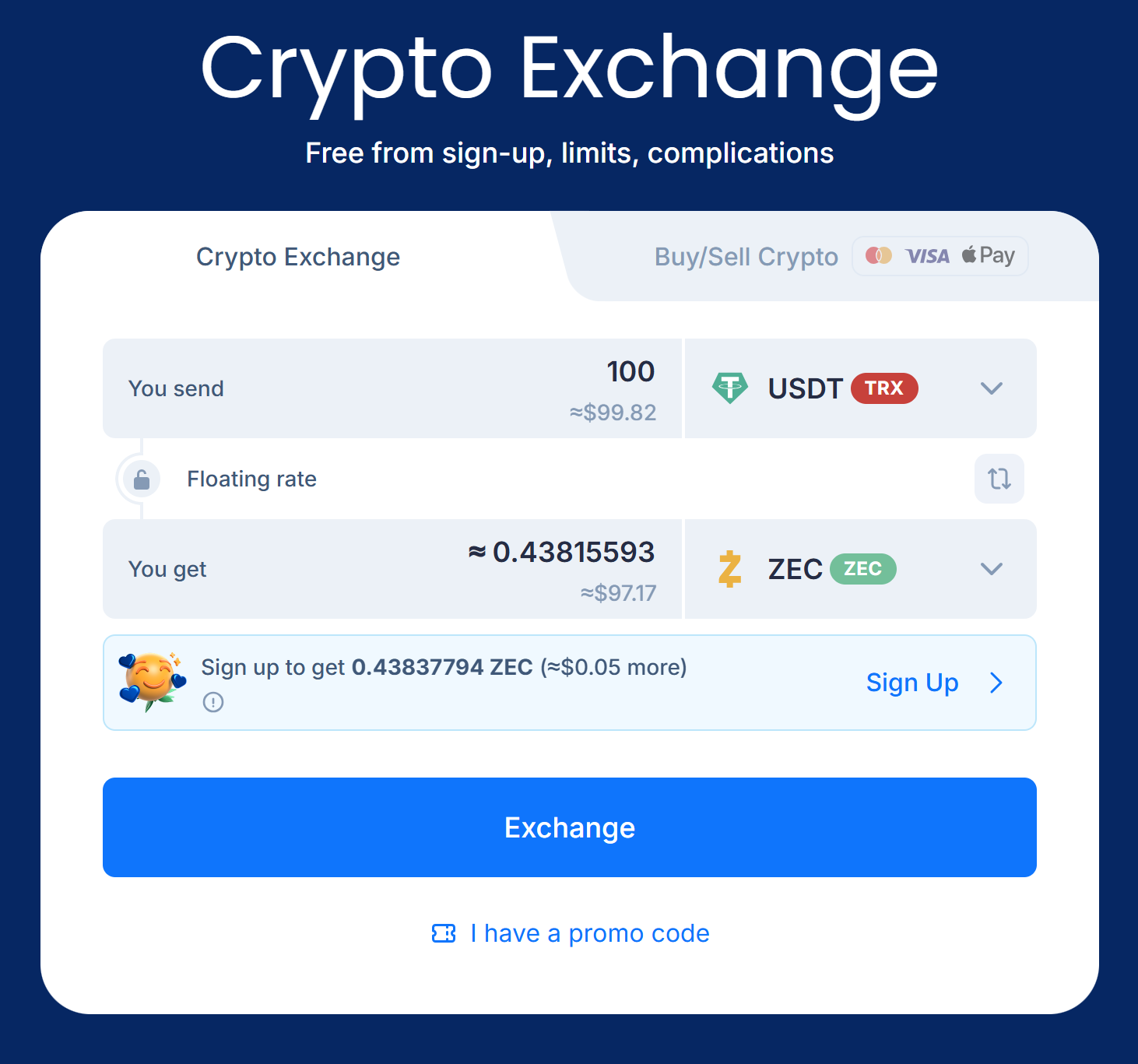
1. Open SimpleSwap and choose Crypto Exchange.
2. In You Send, pick your coin (for example, USDT, Ethereum, Bitcoin). In You Get, select ZEC (or any other coin of the vast selection provided on SimpleSwap). Click Exchange.
3. Add your receiving address (so funds land where you’ll use them), and click Create an exchange.
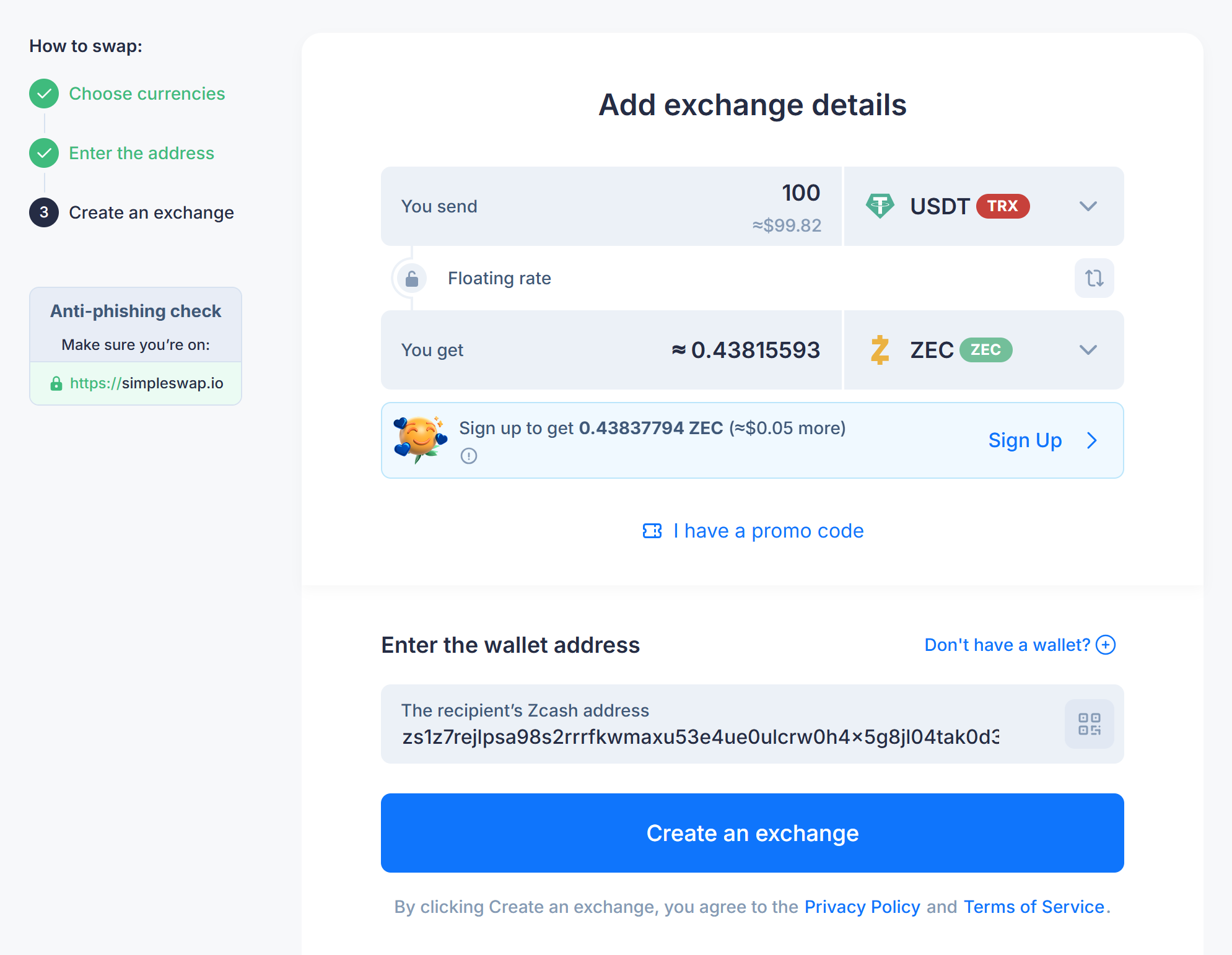
4. Receive your ZEC (typically within minutes).
An extensive variety of coins are also available for buying/selling for fiat on SimpleSwap.
Zcash ETF vs Direct ZEC
The cleanest way to think about this is “convenience and wrappers” versus “control and utility.” The two routes can express the same thesis, yet the day-to-day experience is totally different.
A Zcash ETF tends to suit investors who want brokerage access and familiar reporting, plus the comfort of institutional custody. Direct ZEC tends to suit users who want to hold and use ZEC, including privacy features, and who accept the work that comes with self-custody.
Practical Differences at a Glance
Aspect | Zcash ETF | Direct ZEC |
Ownership | No direct ZEC ownership; holds ETF shares. | Full ownership of ZEC in a wallet or account. |
Custody & security | Custody handled by regulated institutions/custodians. | User manages wallets, keys, backups, and security. |
Fees | Management fee plus brokerage costs may apply. | Exchange spreads/fees may apply; no ongoing ETF management fee. |
Trading hours | Stock-market hours (plus broker rules). | Crypto markets run 24/7. |
Privacy & utility | No on-chain utility, no shielded usage. | On-chain use, including shielded transactions where supported. |
Regulatory wrapper | Traditional product structure and disclosures. | Depends on venue and jurisdiction; varies by platform. |
Technical knowledge | Low to moderate. | Moderate, with a learning curve. |
Portfolio integration | Easy inside brokerage and some retirement accounts. | Usually separate from trad-fi portfolio tooling. |
Which Strategy Fits Whom?
Different strategies fit different people, and “best” changes with constraints. A good match usually comes from the investor’s operating style, not from the loudest headline.
Traditional Investors
A traditional investor often wants exposure with minimal operational overhead. Brokerage access matters, reporting matters, and custody inside an established framework matters. This persona may like the idea behind Zcash - privacy as a theme, encrypted value transfer as a long-term demand driver - yet they don’t want to manage wallets, seed phrases, or on-chain transfers.
For that kind of investor, an ETF structure can feel like a natural extension of how they already invest. Position sizing, tax docs, portfolio trackers, rebalancing tools, and compliance rules are familiar territory. There’s comfort in knowing that buying and selling happens in the same place as stocks and funds, with fewer moving parts.
That said, the ETF choice is not “set and forget.” Fees can compound over time. Tracking can drift. Liquidity can vary, and flows can follow headlines. With privacy coins, that sensitivity can be amplified, since regulatory narratives can swing sentiment faster than fundamentals do. The product wrapper may reduce operational burden, yet it does not delete market risk.
This route tends to fit people whose goal is price exposure inside a traditional portfolio. Utility is not the focus. Privacy as a lived feature is not the focus. The bet is that ZEC’s market value may reflect growing interest in privacy tech over time, and the investor wants a familiar way to express that bet.
Crypto‑Native Users
A crypto-native user is usually after control. They want to hold the asset, move it, and use it. With Zcash, that use can include shielded transactions and privacy-oriented transfers where supported, which an ETF cannot provide. This persona tends to treat self-custody as part of the point, even if it takes practice to get comfortable.
Direct ZEC ownership fits this style since it keeps optionality open. You can hold long term, you can transact, you can split funds across wallets, and you can adapt quickly when market conditions change. Privacy-focused users often care about censorship resistance and transaction discretion, so an ETF that lives entirely inside brokerage rails may feel like a different product wearing a similar label.
The trade-off is responsibility. Security habits matter. Transfer discipline matters. Emotional control matters during volatility spikes. Direct holders face the full force of crypto’s 24/7 market and the reality that user mistakes can be costly.
Blended Approach
Some investors split the difference. One pattern is holding an ETF-style position inside a brokerage account for long-term exposure, then holding a smaller direct ZEC position for on-chain use. That setup can keep portfolio tooling simple for the bulk of exposure, yet it still leaves room to use Zcash as a network.
This blended route is not about chasing a perfect balance. It’s about separating roles. The brokerage position aims at clean administration. The direct position aims at utility and control. For people who like Zcash’s privacy angle yet still want guardrails around custody for most of their allocation, the split can feel psychologically tidy.
Risks, Regulatory Uncertainty, and Long‑Term Zcash Outlook of Zcash ETFs
Privacy coins sit in a sensitive regulatory category, and that’s not new. The core issue is straightforward: regulators and compliance teams often want traceability, auditability, and clear controls over transaction provenance. Privacy tech pushes in the opposite direction, or at least complicates those expectations. CryptoSlate’s coverage of the proposed Zcash ETF highlights this tension, describing the product as a way to “price privacy without practicing it,” since the ETF wrapper does not use shielded features even if Zcash supports them.
That sensitivity can affect listings, custody relationships, and access over time. Even if a product is designed for compliance, headlines and policy shifts can change what partners are willing to support, and what venues are willing to list. That uncertainty is part of the long-term risk profile for any privacy-coin exposure, ETF or direct.
Then there’s the centralization trade-off introduced by ETF custody. A spot ETF concentrates asset holdings in the hands of custodians and issuers, simply as a byproduct of how the structure works. CryptoSlate described an institutional stack around the Zcash ETF proposal involving Coinbase Custody, Coinbase as prime broker, and BNY Mellon in administrative roles. Critics worry that concentrating large holdings under a few entities can conflict with the decentralization ethos many market participants value, even if the product expands access.
Market structure can shift too. ETF flows can create feedback loops: inflows push buying pressure onto spot markets as the fund acquires ZEC, outflows can push selling pressure during redemptions. CryptoSlate described cash creations as part of the proposed structure, which is the pathway by which ETF demand can translate into spot buying. This can increase short-term volatility, even if the long-term narrative stays constructive.
A simple scenario framework:
If ETF approval or launch accelerates: broader access may support liquidity, yet flows can become headline-driven, and correlation with traditional risk sentiment may rise as more trad-fi allocators trade the product.
If approval is delayed or rejected: the market can see sharp drawdowns tied to disappointment, yet direct ZEC ownership and on-chain use cases remain the core value proposition of the network, independent of the ETF wrapper.
Finally, it’s worth keeping one psychological risk in mind: a trad-fi wrapper can make an asset feel “safer” than it really is. The wrapper can lower operational risk for the end investor. It does not remove market risk, liquidity risk, or narrative risk, and privacy-coin narratives can swing fast.
Round-Up
A Zcash ETF and direct ZEC investing express two different versions of the same idea: exposure to a privacy-focused asset that drew renewed attention after ZEC’s strong 2025 run and the late‑2025 Grayscale filing that kept shaping the 2026 conversation. The main decision hinges on what the position is meant to do: sit neatly inside a brokerage portfolio, or stay usable on-chain.
From SimpleSwap’s viewpoint, users usually cluster into two needs. Some people want simplicity: clean access, fewer operational steps, and familiar reporting. Others want control: self-custody, on-chain transfers, and privacy functionality. Neither need is “more correct,” and many users shift over time.
A short checklist of watch items for 2026 can keep the ETF story in perspective:
ETF filing updates and any changes in the proposed structure.
Custody and authorized participant details, since they shape risk and market mechanics.
Fee disclosures and share-creation mechanics, since they influence long-run cost and tracking behavior.
Changes in exchange availability or policy tone around privacy coins, since access can tighten or loosen quickly.
For readers leaning toward direct ZEC, the non-glamorous parts matter most: wallet hygiene, careful backups, small test transactions, and a steady security routine.
FAQs
What Is a Zcash ETF?
A Zcash ETF is a listed product designed to track ZEC’s price through a traditional exchange-traded structure, so investors can buy shares via a brokerage account instead of holding ZEC directly. In the spot model described in public coverage, the fund holds ZEC in custody and the share price is meant to reflect the value of those holdings, minus fees. This setup gives price exposure, yet it does not give on-chain utility, so ETF buyers cannot send ZEC, receive ZEC, or use shielded transactions through the ETF.
Why Is Grayscale Zcash Trust Filing Important?
Grayscale’s filing matters since it builds on an existing Zcash Trust and puts a well-known issuer at the center of the spot Zcash ETF conversation. Coverage of the proposal describes an NYSE Arca listing plan under ticker ZCSH, with an institutional support stack that includes Coinbase Custody and BNY Mellon roles, which makes the template feel familiar to traditional investors. Just as important, it tests the boundary between privacy-coin narratives and regulated-market requirements, since the ETF wrapper offers exposure without using Zcash’s privacy functionality on-chain.
What Is Direct ZEC Investing?
Direct ZEC investing means buying and holding ZEC itself, often moving it into a wallet where you control the keys. This route gives full ownership and keeps the asset usable on-chain, so you can send and receive ZEC rather than holding a share that represents it. Zcash supports shielded transactions using zk-SNARKs, and direct ownership is the route that can access that functionality where supported by wallets and services. The trade-off is responsibility: security, backups, and transfer discipline fall on the holder.
Are Zcash ETFs Risky?
Yes, they can be risky, though the risk looks different from self-custody risk. Market volatility remains the core risk, and ZEC has shown that it can move fast, including periods of extreme attention and volume spikes. An ETF adds product-specific risks such as ongoing fees, possible tracking differences, and flow-driven price effects tied to creations and redemptions. For privacy coins, policy and regulatory uncertainty can amplify headline risk, and the ETF wrapper does not remove that sensitivity.