

When Is the Next Zcash Halving? Updated 2025–2026 Schedule and Insights


This blog post will cover:
- Introduction
- Current ZEC Market Overview
- Quick Answer: When Is the Next Zcash Halving?
- What Is Zcash Halving and How Does It Work
- Impact of The Blossom Upgrade
- Zcash Halving 2025 Date Confusion
- Past Zcash Halvings: 2020 and 2024
- Historical Impact of Zcash Halvings on Price and Network
- Staying Ahead of the Curve: Buying ZEC Crypto on SimpleSwap
- Round-Up
- FAQ
Introduction
Late 2025 has put halving cycles back on the radar across proof‑of‑work coins, and that attention naturally reaches Zcash (ZEC) too, partly for its privacy-focused coin narrative and partly for its predictable Zcash supply schedule. Even if the next Zcash halving milestone is not around the corner, supply narratives still shape how many ZEC investors' conversations play out, from long-term positioning to short-term sentiment swings.
This article answers “when is Zcash halving” right away, then clears up the Zcash's 2025 halving confusion that keeps circulating. The quick version is that Zcash halvings are triggered by block height, not by a fixed calendar date (to clear the air: the halving "scheduled" for November 2025 is a misperception), so a clean timeline starts with the block number and only then turns into a date estimate.
This piece will touch on several aspects of all things ZEC halving, from outlining past and perspective Zcash halving dates, to mechanics, practical implications, signals to watch, and more.
Disclaimer: This is educational content, not financial advice. Crypto markets are volatile and speculative. Always do your own research (DYOR), consider risk tolerance and time horizon, and never invest money that you can’t afford to lose.
Current ZEC Market Overview
A late‑2025 ZEC market overview starts with a reality check: ZEC token can be liquid enough for everyday trading on large venues, yet it can still behave like a smaller narrative asset during sharp trending news cycles, with price swings.
That mix often creates “fast markets,” where price, social attention, and liquidity all change at the same time. For readers new to crypto, it helps to think of ZEC as a coin that can react to headlines more than many people expect.
Three themes tend to drive ZEC volatility into 2026, even without a perspective of a near-term Zcash halving date. First is the privacy coin narrative itself. Zcash sits in a category where public perception matters a lot, so shifts in public discussion around privacy tech can move sentiment quickly. Second is platform policy risk. Any changes in how large venues handle privacy-related assets can act as a catalyst, even if the underlying network has not changed.
Third is the broader crypto market sentiment cycle. When the market is in a risk‑seeking mood, traders often look for strong narratives. When the mood turns cautious, liquidity can flow back into majors, and ZEC can feel the air coming out.
For 2025–2026, a context-first approach is to track a few inputs on a weekly or monthly rhythm, without trying to predict a single outcome:
Volume and liquidity
Watch whether spot volume is rising with price (healthier) or falling as price rises (often fragile).
News catalysts
Track policy updates, major wallet or infrastructure announcements, and credible ecosystem updates that can change the story people tell about Zcash.
Relative strength versus the broader market
If ZEC is rising but the rest of the market is flat, that can signal narrative-led flows. If ZEC is moving only because everything moves, that’s a different regime.
Volatility regime
A quiet period can flip fast. Keeping a note of average daily ranges can help set expectations about risk.
Macro sensitivity still matters too. Crypto frequently trades as a “liquidity asset class” during certain phases, meaning global risk appetite can influence ZEC even if Zcash-specific news is quiet. That does not mean ZEC is only macro-driven. It means a Zcash outlook 2026 that ignores macro entirely often feels confusing in real time, since markets rarely move in one clean storyline.
Quick Answer: When Is the Next Zcash Halving?
The next Zcash halving will occur at block height 4,406,400, and it is commonly projected for late 2028 (often estimated around November, with the exact date dependent on real block production). The key point for readers sorting through conflicting pages is simple: the next halving is not scheduled for 2025 or 2026.
It also helps to know what the date of halving Zcash really means in practice. Zcash halving events are coded around block heights, so the height is fixed and the date is an estimate that can shift as block times vary. That’s why a ZEC halving countdown widget can be useful for rough planning, yet it should not be treated like a hard deadline. The schedule anchor for 2028 halving is still “Zcash block 4,406,400,” not any specific day on the calendar.
What Is Zcash Halving and How Does It Work
The word “halving” gets used like it’s a market event, but at heart it’s a monetary policy rule. This part is meant to be easy to skim, especially for readers with limited crypto background.
Understanding Zcash Halving Event
A Zcash halving is a protocol-defined event that cuts the Zcash block reward in half at a predetermined point in the chain’s history. It’s tied to block height, so it happens when the network reaches that block number, not when a calendar reaches a specific date.
To put it simply: every time miners produce a new block, new coins are created as a reward, and a halving reduces that reward, slowing the rate of new ZEC entering circulation. One clean framing is: what halving changes: new supply rate. What it doesn’t: any promise of a price pump, a guaranteed rally window, or a repeat of past patterns.
One more subtle detail for readers inquiring about the halving events happening approximately every four years. Zcash’s timeline lines up roughly with multi‑year cycles, yet the network has had major upgrades that changed block timing assumptions, so “four years” is a helpful shorthand, not a perfect rule for calendar predictions.
Zcash Halving Mechanics
Mechanically, Zcash halvings happen automatically. After a fixed number of blocks, the block subsidy drops by 50%, and that reduces the pace of new issuance. The effect is gradual in the sense that nothing changes for users on a day‑to‑day basis, yet the long-term total supply curve changes meaningfully, and markets often trade narratives around that shift.
Zcash’s economics are often summarized in a few numbers that anchor the whole idea. Zcash cryptocurrency has a fixed maximum supply of 21 million ZEC, and the network aims for a new block roughly every 75 seconds. The Zcash block reward 2025 was 1.5625 ZEC per block as of November, and the block reward cuts in half about every four years until the supply approaches that 21 million cap. This is the practical meaning of “Zcash supply schedule” for everyday readers: a predictable issuance curve that trends toward lower inflation over time.
Zcash is also a proof‑of‑work network that uses Equihash, designed to be memory‑hard with fast verification. For non‑technical readers, the takeaway is not the math. The takeaway is that miners compete to produce blocks, they receive rewards, and a halving reduces those rewards, so the network mints fewer new coins per unit of time than before.
Impact of The Blossom Upgrade
Blossom is the technical turning point that explains a lot of the timeline confusion people see online. The Blossom upgrade changed Zcash’s target block spacing, shortening it from 150 seconds to 75 seconds. Zcash’s own economics explainer also frames issuance around roughly 75‑second blocks, which is the post‑Blossom world most users live in today.
That block-time shift created a problem to solve: if blocks arrive twice as fast, emission per unit of time would rise unless something else changes. The solution was an adjustment to the per‑block reward at the time of the upgrade, and ZIP 208 documents the shorter block spacing design. For readers trying to reconcile charts, this is the practical outcome: old writeups that assume the original spacing and the original “blocks per halving” can produce wrong calendar conclusions, even if the author is not trying to mislead.
Zcash Halving 2025 Date Confusion
If a search result claims that Zcash halving happened in 2025, it’s worth checking your sources. Confusion is common in crypto content, partly from templates and partly from schedule changes that casual summaries fail to include.
Where the “Zcash Halving 2025” Claim Comes From
Most “Zcash halving happening in November 2025” claims come from one of three patterns.
First, some pages were written with outdated assumptions. Before Blossom, the network used different timing parameters, and Blossom changed target spacing. A page that mixes old block-time assumptions with a new calendar estimate can land on the wrong year, and the mistake can persist when other sites copy the same numbers.
Second, many halving articles are made from reusable templates. If the writer is used to coins with a simpler, widely repeated schedule, they may write “every four years” and plug in dates without checking the exact block height trigger. That’s how a page can look confident and still be wrong (about future events, in this case).
Third, calendar-first thinking leads people astray. A Zcash halving date is always an estimate, since the network moves by blocks, not by calendar days. When a page starts with a date, then tries to justify it, the logic can quietly reverse, and the result often looks neat yet fails the block-height check.
How to Verify the Real Zcash Halving Schedule
The safest validation method is block‑height first, calendar second. The widely tracked trigger for the future event is block 4,406,400, with most estimates placing it in late 2028.
A practical checklist that takes less than five minutes:
Confirm the trigger height (look for “4,406,400”).
Cross-check at least two independent trackers that list past halving heights and reward changes.
Sanity-check the network’s timing context through protocol-aware sources that discuss the post‑Blossom target spacing.
Treat the date as a moving estimate. The height is fixed. The calendar projection can shift.
This habit also protects you from “near miss” errors, where a source gets the month roughly right but uses the wrong block height, or vice versa. It’s not about mistrusting everything. It’s about knowing what the protocol actually locks in.
Past Zcash Halvings: 2020 and 2024
Zcash has already gone through two major halvings, and both are easy to summarize as a mini‑timeline of heights and reward cuts.
First halving (2020): November 18, 2020 at block 1,046,400, with the block reward reduced from 6.25 ZEC to 3.125 ZEC per block.
Second halving (2024): November 23, 2024 at block 2,726,400, with the block reward reduced from 3.125 ZEC to 1.5625 ZEC.

Zcash price chart with marked halvings. Source: CoinCodex / TradingView
Readers also run into one more “half-like” event in Zcash history: the Blossom-era adjustment. Blossom reduced target block spacing to 75 seconds, and that shift came with a corresponding economic adjustment that casual observers sometimes label a “technical halving,” even though it’s best understood as emission consistency work around the upgrade.
Since a lot of ZEC halving history posts mix the words “halving” and “reward cut,” understanding Blossom makes the timeline feel coherent again. It’s also a reminder that protocol upgrades can matter as much as scheduled issuance events, especially in how narratives form.
Historical Impact of Zcash Halvings on Price and Network
Halvings influence the supply side. Markets decide what that means on the demand side, and demand is where most uncertainty lives.
Price Behavior Around Previous Halvings
Looking at the past, ZEC has seen periods of strong attention and sharp price movement around halving-related milestones, yet those moves did not happen in a vacuum. Crypto-wide cycles, liquidity conditions, and narrative strength have all played roles in how ZEC traded around major events.
A grounded way to interpret Zcash's halving price impact is to separate three time frames:
Pre-event positioning
Traders often buy the story early if the broader market is receptive, and that can create a run-up that fades before the event even arrives.
Event week noise
The actual halving block can be anticlimactic, since the market has had months to prepare.
Post-event narrative drift
Attention can persist if the broader market stays constructive, or it can vanish if risk appetite drops.
Some sources cite large post-halving percentage moves in certain windows, yet those numbers tend to be highly sensitive to the chosen start and end points. Correlation is easy to find in hindsight. Causation is harder to prove. So it’s more useful to treat halvings as “narrative fuel” that can amplify an existing trend, rather than as a guaranteed trend starter.
Miner Economics and Network Health
A halving cuts the block subsidy, and that changes miner economics directly. Miners who are already operating near break-even often face a decision: upgrade equipment, seek cheaper electricity, redirect hash power elsewhere, or stop mining. That process can influence the network’s hash rate profile, which matters since proof‑of‑work network security assumptions relate to the amount of mining power supporting the chain.
Zcash’s block reward distribution is also worth understanding at a high level. As of November 2024, Zcash’s economics explainer states that 80% of the block reward goes to miners, 8% goes to the Zcash Community Grants Committee (ZCG), and 12% goes to a protocol-tracked “lockbox.” For traders and ZEC holders, the key point is not governance details. It’s that the miner share still dominates, so the miner incentive story remains central after each reward cut.
Network health is not only hash rate. Fees, user activity, and infrastructure support can matter too. Yet for a halving-focused lens, miner incentives and security assumptions are the two pieces that most directly connect the issuance event to real network dynamics.
Staying Ahead of the Curve: Buying ZEC Crypto on SimpleSwap
Event-driven markets tend to reward planning more than urgency. If someone wants exposure to ZEC with the next halving far away, the best “action” is often building a decision framework that can survive noise, not chasing a date.
A practical mini flow that keeps the process honest:Set thesis → pick time horizon → choose accumulation method → define risk limits.
Set thesis
Decide what the bet really is. Is it a privacy coin narrative view, a supply schedule view, a “market cycle” view, or a mix? If the thesis is unclear, every headline feels like a reason to change direction.
Pick time horizon
A halving thesis tends to be multi‑year by nature, yet many people still want flexibility. That’s fine, but it helps to label the position: short-term trade, medium swing, long-term hold. The label affects risk limits.
Choose accumulation method
Many people reduce regret by spreading entries over time rather than trying to pick a perfect day. A simple approach is staged buys across weeks or months, with predefined maximum exposure. It’s not glamorous, but it matches how volatile assets behave in real life.
Define risk limits
Decide in advance what would invalidate the thesis, and decide what drawdown feels unacceptable. That step is often skipped, then people improvise in the worst moment.
If swapping into ZEC, many users prefer a straightforward swap flow that lets them convert one asset into another without turning it into a multi-step ordeal.
SimpleSwap can be used as an execution venue for swapping into ZEC, and it fits best when it’s treated as a tool for disciplined entries and exits, not as a source of signals.
This is how it goes:
1. Open SimpleSwap and choose Crypto Exchange.
2. In You Send, pick your coin (for example, USDT/BTC/ETH). In You Get, select ZEC (or any other coin of your choosing). Click Exchange.
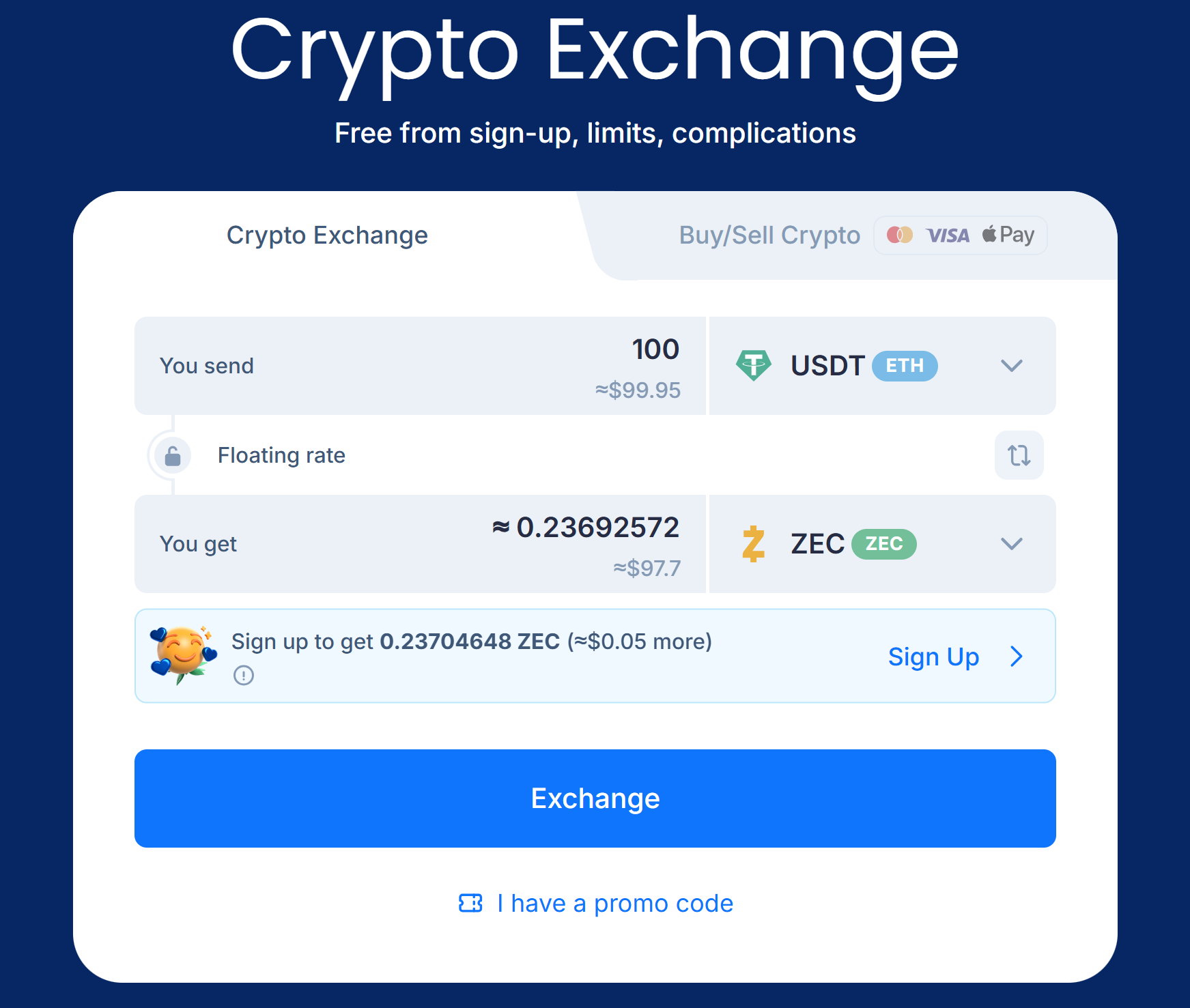
3. Add exchange details
Paste your receiving address (so funds land where you’ll use them), and click Create an exchange.

4. Receive your ZEC (typically within minutes) – no registration required.
The careful bits stay the same across any platform: confirm the asset ticker, confirm the network, double-check the address, and keep size aligned with risk tolerance.
SimpleSwap also permits buying ZEC, as well as a vast variety of other cryptocoins, for fiat.
Round-Up
The next Zcash halving is expected at block 4,406,400 and is widely projected for late 2028, so the correct answer is not “ZEC halving 2026.” That timeline matters, since it reframes what 2025–2026 is really for: learning how the Zcash supply schedule works, tracking the drivers that move ZEC regardless of the halving’s distance, and building a plan that doesn’t crumble during volatility.
Past events show that halvings can act as narrative magnets, yet market outcomes still depend on liquidity, sentiment, and timing across the wider crypto cycle. So the best preparation is simple and slightly unexciting: follow block-height facts, treat date estimates as estimates, and keep risk decisions explicit instead of implied.
FAQ
What Is Zcash Halving?
A Zcash halving is a scheduled reduction in the Zcash block reward that lowers the rate of new ZEC issuance over time. It affects supply flow, not demand, so it does not promise any specific price outcome, even if narratives and speculation often intensify around halving windows.
When Is the Next Zcash Halving?
The next Zcash halving is triggered at block height 4,406,400, and most trackers place it in late 2028, often around November under current assumptions. The block height is fixed, and the calendar date can shift as real block production varies.
When Will the Last Zcash Halving Happen?
Zcash follows a capped supply model with a maximum of 21 million ZEC, and block rewards keep halving over time as issuance trends toward that cap. A precise “last halving year” is a deep protocol-math question, and most readers don’t need that date for practical 2025–2026 decision-making, so it’s safer to treat it as a long-horizon concept tied to the emission schedule rather than a near-term milestone.
Why Some Sources Still Say “Zcash Halving 2025”?
Those claims often come from outdated content, template reuse, or misunderstandings tied to the post‑Blossom timing shift to 75‑second blocks. The most reliable verification method is block-height first, then date estimates after, since the protocol triggers halvings by height, not by calendar. The next actual halving is expected in late 2028.
What is the Zcash Block Reward?
The Zcash block reward (often called the block subsidy) is the amount of newly issued ZEC created with each new block and paid out by the protocol, separate from any transaction fees included in that block. In the current era after the 2024 halving, Zcash’s published economics list the block reward as 1.5625 ZEC per block. The same source describes how that subsidy is allocated: 80% to miners, 8% to the Zcash Community Grants Committee (ZCG), and 12% to a protocol-tracked lockbox, so “block reward” is also a funding mechanism, not just a miner payout.
When and Why do Zcash Halvings Happen?
Zcash halvings happen when the chain reaches specific block heights, so the trigger is a block number, and any calendar “date” is only an estimate. Zcash halving mechanics are commonly summarized as a 50% reward cut every 1,680,000 blocks, which roughly lines up with multi‑year cycles under normal conditions. The reason is monetary policy by design: Zcash’s issuance is intended to slow over time, supporting a capped-supply model and reducing new-coin creation as the network matures.