

What Is Render Crypto? A Complete Guide to the Render Network and RNDR Token



This blog post will cover:
- Introduction
- What Is Render Network?
- Render’s Key Innovations
- How the Render Network Works
- RNDR Crypto and RENDER Coin Explained
- Burn‑and‑Mint Equilibrium (BME) Explained
- Tokenomics
- Key Use Cases and Real‑World Adoption
- Historical RENDER Coin Price Performance
- Buying or Swapping for RNDR/RENDER on SimpleSwap
- Future Outlook for the Render Network
- Round-Up
- FAQ
Introduction
Render is often described as a decentralized GPU compute and rendering network - a place where people who need heavy graphics or AI-style compute can connect with people willing to supply it. For anyone searching “what is RNDR token” or “RENDER ERC20”, this Render Network guide breaks down the basics without assuming deep crypto knowledge, including how the network is structured and why the token exists.
From interest in the Render token news today we see that this topic matters, and for a simple reason: demand for GPU time keeps rising, pushed by 3D content creation, visual effects pipelines, and AI workloads that can get pricey fast. The guide below covers Render fundamentals, clears up RNDR vs RENDER (a common point of confusion), touches on aspects of a Render price prediction, and explains tokenomics concepts like burn-and-mint equilibrium in plain language.
Disclaimer: This is educational content, not financial advice. Crypto markets are volatile and speculative. Always do your own research (DYOR), consider risk tolerance and time horizon, and never invest money that you can’t afford to lose.
What Is Render Network?
Render Network can be thought of as a decentralized marketplace that connects creators who need GPU power with node operators who provide GPU compute power. Instead of relying on a single cloud vendor, the idea is to route work across a distributed pool of providers.
Core Concept and Participants
Render Network has three core “participants” that a beginner should picture: creators, node operators, and the Render Foundation.
Creators are the demand side. They might be motion designers, small studios, 3D artists, or teams running compute-heavy jobs who want more rendering capacity than a single workstation can provide.
Node operators are the supply side. Think of a person with a strong GPU rig that sits idle overnight, or a small mining-style setup repurposed for compute. They can take on jobs and receive token-based compensation for providing that GPU time.
A simple example makes it click: a small animation studio needs thousands of frames rendered before a morning client review, yet their in-house machines will not finish in time. A node operator, sitting elsewhere with spare GPU capacity, can process part of that workload and get paid for the service.
The Render Foundation sits above the marketplace layer as the ecosystem steward, tied to governance and development direction, with current governance centered on the upgraded token on SOL.
Render’s Key Innovations
Render’s pitch is not “another token for artists”. The network tries to make GPU access more flexible and market-driven, with guardrails that reduce trust assumptions between strangers.
People interested in Render coin news are primarily focused on how the project leverages its GPU network for AI and 3D rendering, alongside the key innovations it brings to the table.
A few practical innovations show up again and again in Render discussions. One is the decentralized GPU marketplace model itself, which aims to widen supply beyond a single provider, helping creators scale up or down without long-term contracts. Another is the workflow approach around verification concepts and conditional payment, designed to reduce the fear of “paying first and hoping for delivery”.
A third is incentive alignment through token-based settlement, so providers have a reason to deliver valid work and creators have a clear payment path. A fourth is the general “GPU DePIN” framing, where physical hardware contributes to a network and gets rewarded, giving GPU owners a way to monetize idle time.
Those ideas become clearer in the next section, since the job workflow is where most newcomers finally see how the pieces fit together.
How the Render Network Works
Most readers do not need code to understand Render crypto. They need a mental model of what gets submitted, what gets checked, and when value changes hands.
The workflow below describes the typical path from a submitted job to an accepted result.
From Job Submission to Verification
A Render job starts with a creator packaging the work they want done. In practical terms, that might be a set of scene files, a sequence setup, or a defined compute task that the network can process. For a concrete picture, imagine a motion designer exporting a 20-second animation that needs thousands of frames rendered overnight, aiming to wake up to a completed sequence.

Source: Coingecko
After submission, the job is routed to one or more node operators who have the right capacity for it. The nodes do the compute work, then return outputs that can be checked against expected results. The key idea is that the network uses verification or “proof” concepts so a creator is not forced to trust a random provider blindly. Once the output passes the agreed checks, payment can move forward as planned, rather than being released upfront.
For a beginner, the operational takeaway is simple: submit work, wait for assigned compute, expect validation steps, and expect settlement after acceptance rather than at the first click.
Watermarking, Delivery, and Settlement
Render-style workflows often use interim protections such as watermarking concepts, letting creators review progress without receiving a clean, fully usable version too early. That can matter for studios working on paid ads, game assets, or client materials where leaks cause real damage.
Once the final output is ready and checks pass, the creator receives the deliverables in a form meant for real use - clean frames, final renders, or completed compute outputs, depending on the job type. Settlement is structured to match incentives on both sides.
The creator expects delivery that meets the job spec, and the node operator expects payment after valid completion, rather than dealing with vague “trust me” arrangements.
What this means for users is pretty grounded. Creators can reduce IP risk during the process, and node operators can rely on a clearer payout path once valid work is delivered.
RNDR Crypto and RENDER Coin Explained
A lot of confusion around Render cryptocurrency comes from the token transition: RNDR coin existed first, then RENDER token became the upgraded standard tied to Solana.
The clean way to read it is that RNDR refers to the legacy token standard, and RENDER refers to the newer token that the ecosystem is moving toward for network use and governance.
RNDR (ERC‑20): Origins and Distribution
RNDR launched as an ERC‑20 token on Ethereum and was the original unit used to represent value transfer in the Render ecosystem. Public materials commonly describe a capped supply model, with one widely cited figure putting the cap at 536,870,912 RNDR.
Distribution discussions often mention that a meaningful share of tokens sat in escrow, with that escrow concept framed as a way to manage supply and demand as network usage grows and shrinks over time.
That early structure matters today mainly for context. It explains why trading history of the RNDR token exists across venues and why some users still hold legacy assets even as the network’s support focus shifts.
RENDER (Solana): The Upgraded Token
RENDER is the Solana-based successor token used by the Render ecosystem, created after a community decision to move the network to the Solana blockchain and mint a new token standard for that chain. In the Render Foundation’s own wording, Solana was selected for speed, lower fees, and capacity to support the broader network vision, and the Foundation states its main support is now centered on RENDER rather than legacy RNDR.
This means more ecosystem activity, governance, and long-term feature work is expected to cluster around the Solana token standard. RNDR still exists on Ethereum, yet the “active” network direction points toward RENDER.
What Happens to Old RNDR Tokens?
Old RNDR tokens still exist on their original chains, yet holders will keep seeing the ecosystem move away from them. The Render Foundation states that RNDR on Ethereum will no longer be maintained by the Foundation and will not be usable on the Render Network itself. The Foundation describes the official upgrade as a 1:1 ratio, meaning 1 RNDR upgrades to 1 RENDER.
The Foundation says RNDR is burned in advance of receiving the RENDER transfer, and the upgrade is one-way from Ethereum or Polygon to Solana. For trading and transfers, it helps to check tickers, chain labels, and venue support carefully, since “RNDR” and “RENDER” can lead to very different assets depending on where they are listed.
Burn‑and‑Mint Equilibrium (BME) Explained
Burn-and-mint equilibrium (BME) is Render’s way of linking token flows to real network activity. The Render knowledge base describes a model where creators pay for rendering and AI jobs in RENDER, and that RENDER is burned after work completion, removing tokens as services are consumed.
The same source describes predictable emissions that reward network participants, with emissions distributed on a predefined declining schedule and allocated across epochs tied to network usage.
A simple analogy: tokens get taken out of circulation when work gets paid for, and tokens get created on a schedule to reward the people providing compute. The balance between those two forces is the point of BME, and it gives readers a lens for thinking about sustainability beyond hype headlines.
Tokenomics
Render tokenomics are easier to follow if the focus stays on “how value flows” rather than on memes or price talk. On the demand side, tokens (or token-denominated credits) get spent for GPU compute services, and the network’s BME description ties job payments to burning RENDER as work completes.
On the supply side, node operators and other participants can receive emissions and incentives, which the Render knowledge base frames as predictable token emissions distributed on a schedule and allocated by usage-based epochs.
This creates a push-pull dynamic. Higher network demand can translate into more token burn tied to jobs, and participant rewards continue via the emissions plan described in the BME materials. Lower demand can shift the feel of that balance, so the model is worth understanding before a reader treats the token like a simple “number go up” asset.
Common misconception: token price is not a guarantee of network adoption, and network usage is not a guarantee of token price strength. Markets can move on liquidity, sentiment, and broader cycles even as product usage tells a different story.
Key Use Cases and Real‑World Adoption
AI, 3D, VFX, and Gaming
Render’s most natural use cases sit wherever GPU time becomes a bottleneck. For AI, teams may seek compute for model-related workloads or experimentation, especially for tasks that spike in short bursts.
For 3D and VFX, the “render a lot of frames fast” problem shows up constantly, from ad agencies to small film teams. Gaming fits too, since studios build large libraries of assets, lighting passes, and cinematic sequences.
A scenario-style example: an indie game studio needs to render promotional cinematics, an NFT artist wants high-resolution generative visuals without buying new hardware, or a small VFX crew needs extra capacity near deadline. Those map cleanly onto broader GPU demand trends that keep accelerating.
Adoption Signals and Network Activity
Adoption is tricky to measure from the outside, so it helps to look for repeatable signals. Market data sources can hint at sustained interest too.
For example, CoinMarketCap lists roughly 203.50K holders for RENDER at the time its page data was captured, and it reports daily trading activity via 24-hour volume figures. Those are not perfect “usage” proxies, yet they do suggest ongoing attention and liquidity.
Another healthy signal is resilience through cycles. If a network keeps attracting creators and operators across bull and bear markets, that tends to point toward product-market fit rather than pure speculation. Readers can cross-check this idea using multiple public dashboards and reputable trackers, not a single screenshot or social post.
Historical RENDER Coin Price Performance
RNDR/RENDER has traded through multiple market phases, so volatility should not surprise anyone looking at longer charts. As of mid-December’s 2025 price chart, CoinMarketCap showed the RENDER price at about $1.40 per token, quoted in USD, and RENDER market cap of $718.08M, total supply of 533.34M RENDER, and circulating supply of 518.58M.
The same page lists an all-time high of $13.60 dated Mar 17, 2024 and an all-time low of $0.03676 dated Jun 16, 2020, with the usual caveat that different data providers can show small differences.
RNDR → RENDER migration adds another layer: some chart histories show RNDR value, some show price of RENDER, and tickers can be mixed across venues, so comparisons need extra care. A simple way to read RNDR/RENDER price history:
Cycle context: map peaks and drawdowns to broader crypto market cycles, not a single headline.
Liquidity and volume: look at whether big moves happen on thin volume or broad participation (24h volume is a basic check).
Catalyst-driven moves: separate “network updates” from “market-wide risk-on days” so price action does not get misread as pure adoption.
Buying or Swapping for RNDR/RENDER on SimpleSwap
This section sticks to the basic flow a typical user sees, without assuming any special tools or trading background.
RENDER is available for purchase or exchange on SimpleSwap, just as nearly 1,500 other cryptocurrencies. The process is fairly straightforward:
1. Open SimpleSwap and choose Crypto Exchange.
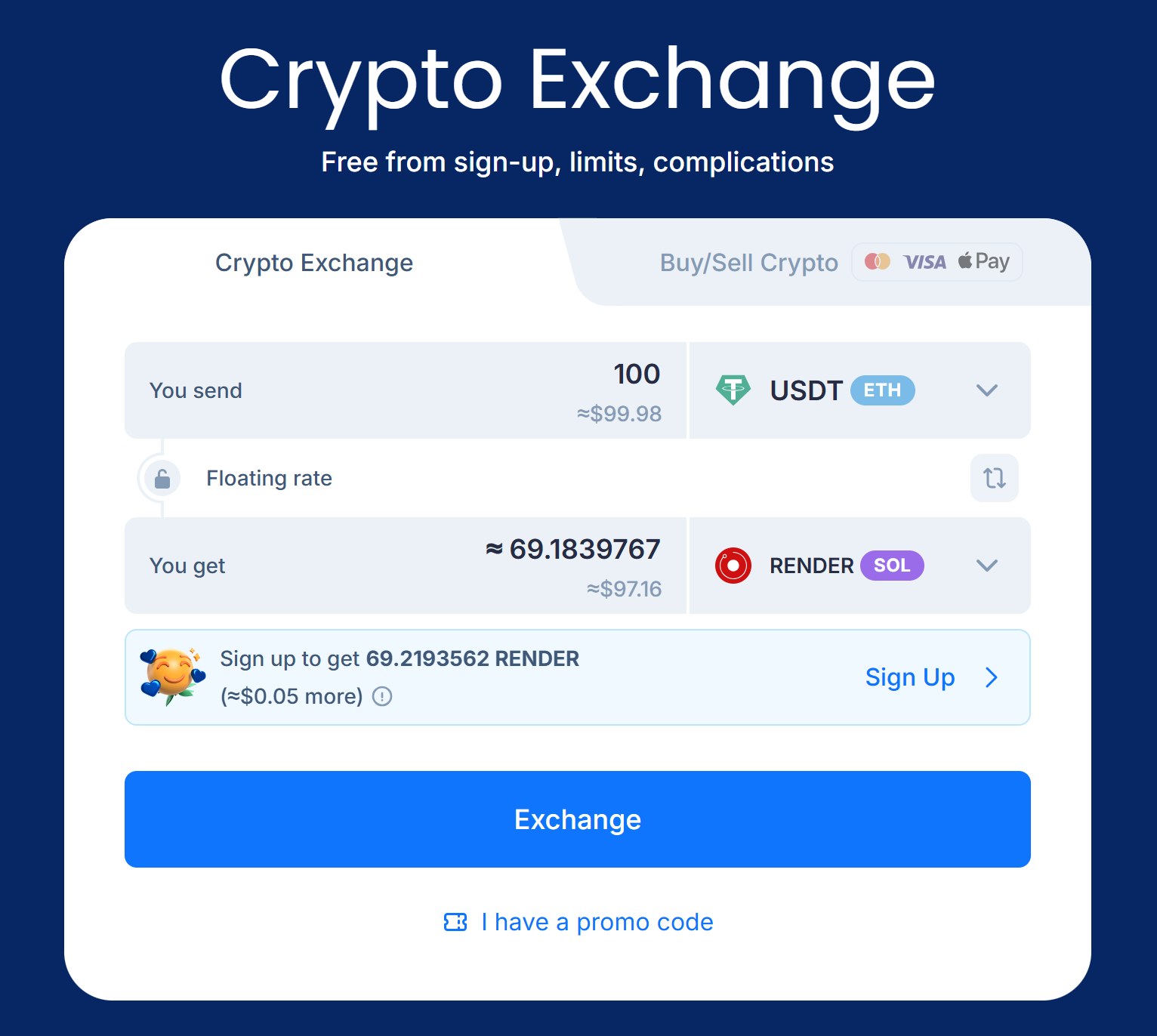
2. In You Send, pick your coin (for example, USDT). In You Get, select RENDER, or any other coin of your choosing.

*The RENDER wallet address on the picture is provided for example purposes only, it is not a real address.
3. Click Exchange, paste your receiving address (so funds land where you’ll use them).
4. Confirm the rate and send your deposit.
5. Receive RENDER (typically within minutes), no registration required.
Users can also buy cryptocurrencies on SimpleSwap with fiat using debit or credit cards. On the RENDER coin page users can also monitor the up-to-date RENDER price USD and other key parameters.
Be vigilant! A cautious mindset applies to everyday swaps: verify ticker, chain, and the receiving address.
Future Outlook for the Render Network
Render’s direction is often discussed alongside AI infrastructure and “real hardware” crypto networks. The interesting part is whether the network keeps attracting real workloads and reliable compute supply.
Growth Drivers and Roadmap Themes
Render’s growth drivers connect closely to rising demand for GPU compute in AI and digital content, plus broader interest in DePIN-style networks that coordinate physical resources.
Community decisions already pushed the token and network center of gravity toward SOL, with the Foundation describing the upgrade and its focus on RENDER for future support. Execution still matters most: reliable outputs, enough node capacity, and enough creator demand to keep the marketplace active.
Where Render Fits in a Crypto Portfolio Perspective
From a “portfolio perspective”, Render is usually grouped with infrastructure and DePIN-style tokens, tied to the theme of compute demand rather than payments or memecoins.
Builders, GPU owners, and users who like infrastructure narratives often find it interesting as an ecosystem concept. None of that removes the core risks: token prices move fast, narratives rotate, and custody choices carry responsibility. Education and position sizing discipline matter more than a catchy thesis.
Round-Up
Render is a decentralized GPU marketplace concept that links people who need compute with people who can supply it, with token-based settlement as the coordination layer.
The big beginner trap is the naming split: RNDR refers to the legacy token on older chains, and RENDER is the upgraded token standard tied to Solana and current ecosystem focus. That split can affect swaps, chart comparisons, and even basic wallet address choices.
On the tokenomics side, Render’s burn-and-mint equilibrium is meant to connect real network usage to token flows, burning tokens tied to completed work and distributing emissions to participants on a schedule described in the project’s BME materials.
For readers, the best approach is to treat Render as a real product idea first (GPU supply and demand), then treat the token as the market’s evolving way of pricing that idea.
FAQ
How Do I Buy Render Token (RENDER)?
On SimpleSwap, a typical flow is: pick the asset to pay with and select RENDER (RNDR being its legacy token) as the asset to receive, paste the receiving address, confirm the swap details, then send the deposit shown on-screen. Before confirming, double-check the ticker and the network label, since RNDR and RENDER can be listed separately across venues and chains. The up-to-date RENDER pricing can be monitored on the respective coin page on SimpleSwap.
What is RENDER?
RENDER is the upgraded Render token standard on Solana, created after the network’s community decision to move from Ethereum to Solana and mint a new token for that chain. RNDR still exists as a legacy token, and there is an official migration path that upgrades RNDR to RENDER at a 1:1 ratio.
What is the Render Token (RNDR) Price Today?
“Price today” usually means the current spot price on a given tracker or exchange, and it can vary a bit across venues. For a quick reference, CoinMarketCap listed RENDER crypto price at about $1.40 (USD) at the time its page data was captured. Always confirm the ticker and chain, since RNDR vs RENDER mix-ups can lead to checking the wrong chart.
What is Render All-Time High?
ATH means the highest recorded price on a dataset, and the exact ATH can differ slightly between providers based on which exchanges and calculation methods they use. CoinMarketCap lists Render’s all-time high as $13.60 on Mar 17, 2024. Verify the asset label (RNDR vs RENDER) before treating any RENDER token price ATH as definitive.
What is the Render Token All-Time Low?
ATL means the lowest recorded price on a dataset, and early-market trading can exaggerate lows when liquidity is thin. CoinMarketCap lists an all-time low of $0.03676 on Jun 16, 2020. Interpreting ATL works best with context like market maturity and broader cycle conditions, not as a single “true value”.
How do I Bridge Render Token (RENDER)?
Bridging moves assets across chains using approved routes, and the main risk is sending to the wrong network or interacting with fake links. The Render Foundation states the official RNDR → RENDER upgrade is one-way from Ethereum or Polygon to Solana, and it points users to official portals and scam warnings. Use official ecosystem resources, verify contract details, and test with a small amount first.
What Can You Do with Render Token (RENDER)?
RENDER is used as the token tied to Render Network activity and governance direction, with the Foundation stating that voting and governance occurs with RENDER on Solana. In the BME model description, creators pay for jobs in RENDER and that RENDER is burned after work completion, and emissions reward network participants on a schedule. Like any crypto asset, it can be held or traded, and volatility plus self-custody risk remain part of the deal.