

How To Buy ZCash and Should You Even Do That? Must-Knows About ZEC Before Purchusing


This blog post will cover:
- Introduction
- What Is Zcash (ZEC)
- Zcash Market Performance Overview
- Why Zcash Matters in 2026
- Why Some Investors Consider Buying ZEC
- How To Buy Zcash
- Risks and Responsible ZEC Use
- Round‑Up
- FAQ
Introduction
Privacy is back on the agenda in 2025. People see more data collection, more identity checks, more public ledgers, and they start asking a simple question: “Do I really want every transaction I make to be readable by anyone?” That renewed attention has put privacy coins back in the spotlight, and Zcash is one of the first names that comes up.
This article gives an overview for newcomers who want clarity before deciding to buy Zcash. You’ll learn how Zcash privacy works, what ZEC in 2025 has looked like from a market perspective, and what might shape its role going into 2026. Then we’ll go through how to buy Zcash safely (from cards to exchanges to swaps) and finish with risks and practical habits for responsible ownership.
Disclaimer: This is educational content, not financial advice. Crypto markets are volatile and speculative. Always do your own research (DYOR), consider risk tolerance and time horizon, and never invest money that you can’t afford to lose.
What Is Zcash (ZEC)
Zcash can sound intimidating at first, mostly from the privacy talk. It gets much easier once you separate the story (why it exists) from the mechanism (how it hides details).
From Bitcoin Fork to Privacy Coin
Zcash coin is a cryptocurrency built on a Bitcoin-like foundation, with an extra option that Bitcoin does not provide by default-transaction privacy. Bitcoin transactions are transparent, meaning addresses and amounts can be traced on a public ledger. Many people like that openness. Others see it as a drawback for everyday money.
Zcash was created for users who wanted a familiar coin structure (a blockchain, peer-to-peer transfers, a capped supply) plus the ability to keep transaction details private when needed. That focus is why it often gets described as a ZEC privacy coin. Put another way, Zcash vs Bitcoin is less about “better” and more about trade-offs: auditability and simplicity on one side, privacy controls on the other.
Zcash Crypto Privacy Made Simple
ZEC uses a form of cryptography known as zk‑SNARKs (Zero-Knowledge Succinct Non-Interactive Argument of Knowledge). The math is deep, yet the idea can be simple: you can prove something is true without revealing the private details behind it. Picture paying a bill and proving you paid, without showing the receipt line-by-line to everyone standing nearby.
In Zcash blockchain, that concept supports shielded transactions. A shielded transfer can hide the sender, the receiver, and the amount from public view, yet the network can still verify the transfer follows the rules (no counterfeit coins, no double-spending).
Zcash keeps another mode too: transparent transactions that look more like classic public-blockchain transfers. That choice matters later, since some users want privacy coin basics for daily spending, and other users prefer transparency for accounting, reporting, or exchange deposits.
Zcash Market Performance Overview
ZEC has gone through the same broad rhythm many crypto assets share: early excitement, long cooling-off periods, then sharp rebounds during stronger market phases. It has rarely moved in a calm, straight line. Big moves can happen fast, both up and down, and quiet stretches can last longer than many first-time buyers expect.
Across past cycles, ZEC market performance has often tracked the wider crypto mood. When liquidity flows into major assets, interest sometimes spills into older altcoins, including privacy-focused projects. During risk-off phases, smaller narratives can lose attention, and ZEC volatility becomes very visible.
One practical point for readers: even if you like Zcash explained as a technology, the market can still price it like a high-beta asset. That means timing, sentiment, Zcash news, and exchange access can matter almost as much as product features. If you’re looking at a Zcash historical chart (useful before you decide to trade Zcash or perform other operations with it), focus less on any single spike and more on the pattern: rapid expansions, deep pullbacks, then periods of rebuilding.
Why Zcash Matters in 2026
Once you move past Zcash price charts, the bigger question is whether Zcash has a role that stays relevant. The answer depends on what you think money should look like online, and how society handles privacy tools.
ZEC Fundamentals and Real‑World Use
ZEC fundamentals start with familiar crypto economics: a capped supply and an issuance schedule that trends downward over time. You do not need to memorize the curve to understand the headline point: new coins enter circulation gradually, and scarcity is part of the design.
What sets Zcash tokenomics apart in day-to-day use is the opt-in privacy model. Zcash payments can be transparent (public details) or shielded (private details), so users can pick the level of disclosure that fits the situation.
Real-world use cases tend to cluster around privacy-sensitive spending: personal transfers, donations, or paying for services where publishing amounts and counterparties feels intrusive. There’s a second category too: experimentation. Zcash has served as a proving ground for privacy tech that other projects and researchers watch closely.
Privacy, Regulation, and the 2026 Environment
The privacy coin environment going into 2026 looks mixed. Public concern about tracking is rising, and that creates demand for tools that reduce exposure. At the same time, regulators and compliance teams pay closer attention to funds that are harder to trace, which can raise friction around listing, deposits, and withdrawals.
Zcash regulation 2026 discussions often land on a nuance: Zcash supports privacy, yet it does not force it for every transaction. Transparent transfers remain available, and wallet developments like unified addresses aim to make user experience smoother without removing choice.
That can support more flexible ZEC compliance approaches for users who want privacy features in some contexts and standard transparency in others. Still, optional transparency does not remove regulatory risk, and local rules can change faster than product roadmaps.
Technology, Ecosystem, and Future Potential
Zcash upgrades 2026 roadmaps often focus on two themes: improving zero‑knowledge technology and making wallets easier for normal people. Many newcomers never use privacy features simply since the interface feels unfamiliar. Wallet UX improvements, unified addresses, and “shielded-by-default” directions in some wallets aim to reduce that hurdle.
The ZEC ecosystem is smaller than the biggest smart-contract networks, yet it stays active. Developers keep refining proof systems and performance, and integrators keep exploring how privacy layers could interact with other chains, bridges, or payment flows. None of that guarantees adoption. It does explain why ZEC future conversations keep resurfacing: Zcash sits at an intersection of privacy needs, cryptographic progress, and real-world constraints.
Why Some Investors Consider Buying ZEC
“Should you even buy ZEC?” depends on your goals. Some people look for utility. Others look for exposure to a privacy narrative. Many do a bit of both.
To further expand on the theme, the “where can I buy Zcash” question will be addressed in the article at a later point (from ways to buy ZEC instantly to the purchase of Zcash via a variety of methods).
Growing Demand for Financial Privacy
Financial privacy is a normal expectation in many parts of life. People close their curtains at night, not from guilt, just from preference. Digital money can feel like living in a glass house, where every transaction becomes a permanent record that strangers can study.
That discomfort is one reason privacy coins demand exists. Users might want to avoid broadcasting personal spending habits, donation history, or business relationships. For lawful use cases, Zcash can function like “cash-like discretion” on a digital rail, with the reminder that discretion still comes with responsibility. If you are asking “why buy Zcash,” that privacy choice is often the first answer, not a Zcash price prediction.
Technology, Upgrades, and Institutional Interest
Zcash upgrades have kept the project on many watchlists. Work related to Halo-style zero‑knowledge systems has been discussed for its impact on scalability and security properties in proof generation and verification, which matters for real-world usability.
ZEC long‑term potential is sometimes framed with cautious optimism in research notes and product discussions, including occasional institutional wrappers in some jurisdictions.
That said, a product existing is not a guarantee of sustained demand, and Zcash value outlook remains highly sensitive to market cycles, regulation headlines, and broader interest in privacy tech. Treat it as a high-uncertainty asset, even if you like the tech story.
How To Buy Zcash
There are several routes, and the “best” one depends on what you already have: fiat money, crypto, or access to a regulated exchange account. Before any purchase, confirm you’re using the correct ZEC network and that your receiving cryptocurrency wallet supports the address type you plan to use. Below is a guide on how to buy Zcash.
Debit Card & Credit Card
To buy Zcash with credit card or a debit card instantly, people typically use a crypto on-ramp or an exchange that supports card payments. The general flow is straightforward: pick a card-supporting provider, create an account, complete identity checks (KYC is common), then select ZEC directly or purchase a widely available coin first and convert it to ZEC later.
Card purchases tend to be fast and convenient, which is why ZEC card purchase routes stay popular. The trade-off is cost. Fees can be higher than bank transfers, and card providers can add their own charges or declines. Start small if you are testing a new provider, and read the fee screen carefully before confirming.
Major Exchanges
If you want to buy Zcash on cryptocurrency exchange platforms, the steps look similar across most centralized services, like Coinbase, for example. Registration and identity verification are standard in many regions. After that, you deposit fiat currencies or crypto ones, then place an order.
A simple path looks like this:
Create an account and secure it (strong password, 2FA).
Complete KYC if required in your region.
Deposit fiat (USD, EUR, or another) or transfer crypto to your exchange wallet that supports ZEC.
Buy ZEC on the spot market, then withdraw to your personal wallet if you plan to store Zcash.
No exchange is “risk-free,” so pay attention to withdrawal rules and regional availability for privacy coins.
P2P
To purchase Zcash P2P, traders use peer‑to‑peer marketplaces or community groups where buyers and sellers meet directly. Many setups rely on escrow to reduce scams: the seller locks coins, the buyer pays via an agreed method, then escrow releases the coins after confirmation.
Peer‑to‑peer trading Zcash option can offer flexible payment rails. It comes with counterparty risk, fake receipts, and disputes. Reputation scores and escrow rules matter a lot here. “No‑KYC Zcash” searches often point people toward P2P, yet legal obligations do not disappear just since a trade is direct. Check local regulations, and treat unusually cheap offers as a red flag.
Apple Pay/Google Pay
Some providers let users buy or sell cryptocurrencies with Apple Pay or Google Pay indirectly. The common pattern of this payment method is: you purchase a supported crypto asset through a mobile-friendly on-ramp, then convert to ZEC on an exchange or swap service.
Mobile payments Zcash routes can feel smoother for people who manage most finances from a phone. Availability varies by country, bank, and provider, and limits can be lower than card payments. Fees can still be meaningful, so it’s smart to compare the final amount of ZEC you receive rather than focusing only on the headline rate.
Spot Market
A spot market that supports Zcash is the simplest trading venue: you exchange one asset for another at current prices, and settlement happens right away on the platform. For ZEC spot trading, you usually choose between a market order and a limit order.
A market order buys instantly at the best available price, which is convenient yet can be a little unpredictable during fast moves. A limit order lets you set a specific price you are willing to pay, and the trade executes only if the market reaches that level.
People who want more control often prefer limit orders, especially for assets known for ZEC volatility. Keep it simple at first, and double-check order type before confirming.
How to Buy Zcash on SimpleSwap
If you already hold crypto and want a direct swap to ZEC, swap services can be a clean path from “I have coin A” to “I want Zcash.”
SimpleSwap is one option that supports this kind of swap-to-Zcash flow in a non‑custodial format, meaning you receive ZEC to your own wallet address rather than storing it on an exchange account. Users can buy ZEC on SimpleSwap for fiat or crypto.
A typical SimpleSwap ZEC tutorial looks like this:
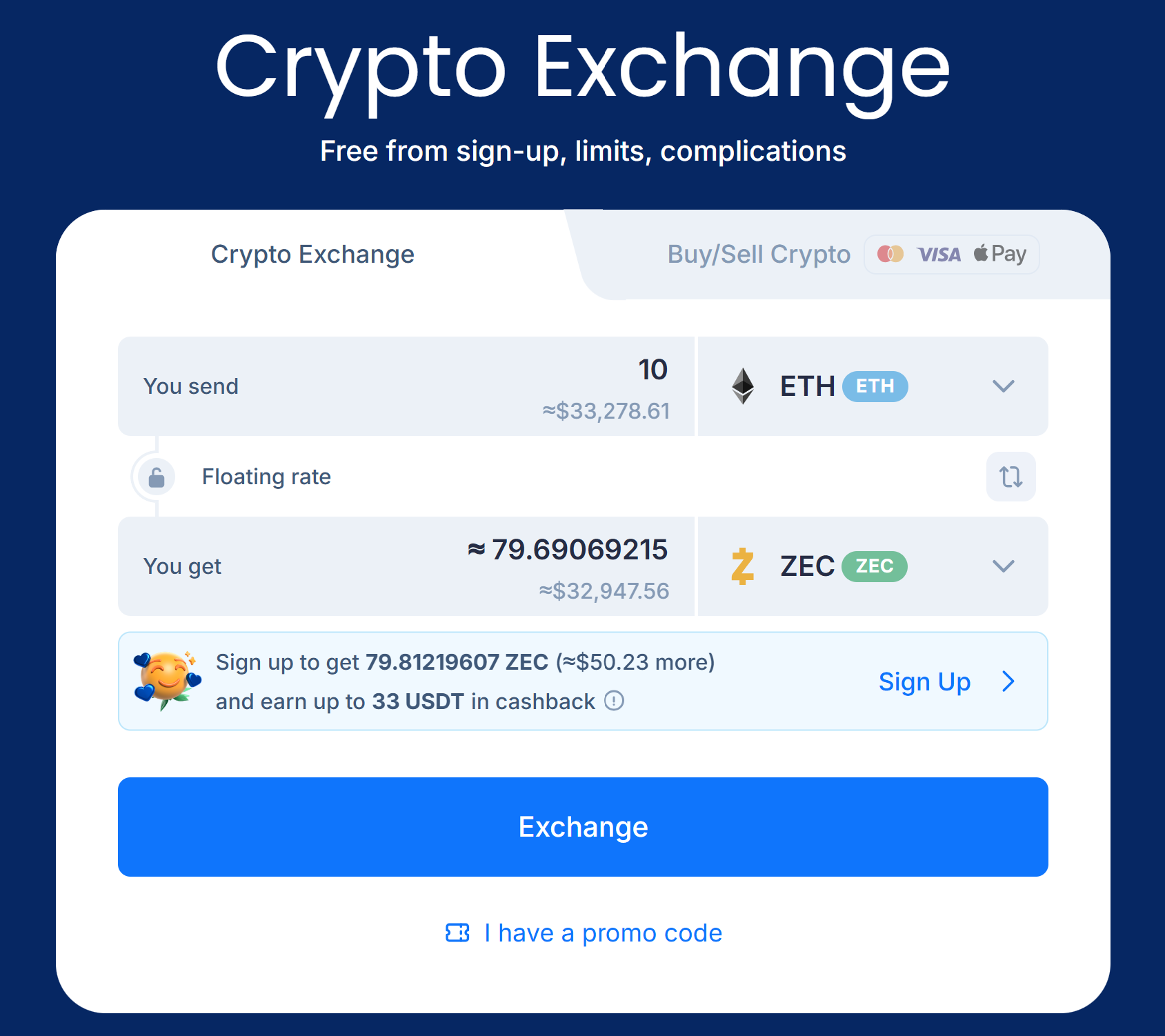
1. Open SimpleSwap and choose Crypto Exchange.
2. In You Send, pick your coin (for example, Ethereum). In You Get, select ZEC, or any other coin of your choosing. Click Exchange.
3. Add exchange details
Paste your receiving address (so funds land where you’ll use them), and click Create an exchange.

The Zcash wallet address on the picture above is provided for example purposes only, it is not a real one.
4. Receive your ZEC (typically within minutes) – no registration required.
Take an extra moment to double-check the ZEC address, confirm your wallet supports the address type, and confirm you are on the right network. Small copy-paste errors can be painful in crypto.
Risks and Responsible ZEC Use
Zcash can be useful, yet it sits in a category that draws attention. Treat risk as part of the package, not as a footnote.
Key Risks to Understand Before Buying
Zcash risks include standard crypto risks plus privacy-coin-specific ones. ZEC regulatory risk is real: exchanges can restrict or delist privacy assets in certain jurisdictions, sometimes with limited notice. That can reduce liquidity, limit on-ramps, and widen spreads.
Market risk remains large. ZEC volatility can lead to sharp drawdowns, even during broader bull phases. There is a risk that demand fades if users shift to alternative privacy solutions (privacy-focused layers, mixing tools, or other privacy coins), or if the compliance burden discourages listings. Another risk is user error: sending funds to an incompatible address type, misunderstanding memo requirements on some services, or losing keys.
Proceed only after checking your local rules and accepting that outcomes vary widely.
Principles for Responsible ZEC Ownership
Responsible crypto investing often starts with sizing: keep exposure limited to an amount you can afford to lose, and avoid borrowing to buy ZEC. Diversification can reduce single-asset stress, and it helps you stay rational during fast market moves.
Security habits matter even more. Use a reputable wallet, back up recovery phrases offline, and consider hardware wallets for larger sums. Privacy features add a twist: if you share addresses publicly, you can weaken your own privacy. Think about how you post donation addresses, invoices, or screenshots.
Taxes and reporting rules vary a lot. For questions that affect filings or legal status, a qualified tax or legal professional can give guidance tailored to your region.
Round‑Up
Zcash is a Bitcoin-like cryptocurrency with an extra switch: optional privacy. That option comes from zero‑knowledge proofs that let the network validate transactions without forcing you to reveal every detail publicly.
In 2025, rising discomfort with tracking has revived interest in privacy coin basics, and ZEC keeps showing up in those conversations for a reason.
Looking toward 2026, Zcash’s relevance ties to two forces that pull in opposite directions: growing demand for financial privacy and tighter oversight of privacy tools. Continued work on zero‑knowledge tech, unified addresses, and wallet usability keeps the project active, yet market access and regulation can still shape what “usable” means in practice.
So, should you buy ZEC? For some people, it fits a clear goal: holding an asset tied to privacy-focused payments and research. For others, the regulatory uncertainty, listing risk, and swings of the price of Zcash make it a poor match.
An informed decision looks less like a leap of faith and more like a checklist: local rules, custody plan, realistic expectations, and a position size that won’t disrupt your finances.
FAQ
What Is Zcash?
Zcash is a cryptocurrency designed for payments with optional privacy. It runs on a public blockchain like many other coins, yet it gives users a choice between transparent transactions (details visible on-chain) and shielded transactions (details hidden). The privacy option uses zero‑knowledge proofs, so the network can validate transfers without exposing sender, receiver, or amount to the public.
What Makes ZEC Unique?
ZEC stands out mainly for its optional privacy design. You can use transparent transfers for simplicity, or use shielded transactions for stronger privacy. Under the hood, Zcash relies on zero‑knowledge proofs to confirm transactions without revealing sensitive details. Unified addresses are another practical feature: they aim to reduce confusion by letting wallets present a single address format that can work across different transaction types, depending on wallet support.
Where To Buy Zcash?
Common options include centralized exchanges that list ZEC trading pairs, swap services that convert one crypto asset into ZEC, and some peer‑to‑peer marketplaces. Availability depends on your region and local rules around privacy coins. Many platforms require identity verification. If you plan to self-custody, set up a ZEC-compatible wallet first, then withdraw after purchase.
Can I Buy Zcash with Cash?
Direct cash purchases are possible in limited cases, yet they are not as straightforward as card or bank methods. Some P2P trades arrange cash meetups, and some regions have third-party services that accept cash-like payments, though availability varies widely. Cash deals carry higher scam risk and personal safety risk, plus legal obligations still apply. If you explore this route, use escrow where possible and verify local regulations first.
Can I Buy Zcash with Debit/Credit Card?
Yes, in many regions you can buy ZEC with debit card or buy Zcash with credit card through exchanges or crypto on‑ramp providers. The typical process includes creating an account, completing KYC checks, selecting ZEC (or buying another coin first and converting), then confirming the card payment. Card purchases are fast, yet fees can be higher than bank transfers, and some banks block crypto-related transactions.
Can I Buy Zcash with Google Pay/Apple Pay?
Sometimes, yes, usually through an on‑ramp or exchange that supports Apple Pay or Google Pay for buying crypto. In many cases, you buy a supported asset first, then swap or trade into ZEC. Availability depends on the country, bank, and provider, and limits can be lower than standard card payments. Always check the final amount of ZEC you receive after fees rather than relying on the headline rate.
How to Buy Zcash Using SimpleSwap?
A common SimpleSwap flow for those looking to buy Zcash is: pick a swap pair, enter the amount, paste your ZEC recipient address, review the rate and minimums, then send the input asset to the provided address. After confirmation, you receive ZEC in your wallet. Double-check the address and wallet compatibility before sending, since crypto transfers are hard to reverse if details are wrong. Useful reminder: SimpleSwap also has a mobile app.