

BTC/USDT Meaning: The Most Traded Pair In a Nutshell


This blog post will cover:
- Introduction
- What is BTC?
- What Is USDT?
- How do Crypto Trading Pairs Work?
- Why Is BTC/USDT the Most Traded Pair?
- BTC/USDT vs BTC/USD
- BTC/USDT vs Other Pairs
- Risks and Strategies
- Round-Up
- FAQ
Introduction
BTC/USDT meaning comes down to a simple idea: it’s Bitcoin priced in Tether, and it’s the most traded crypto pair on many venues, often printing daily turnover well above $30B across markets and data aggregators. That constant flow is a big reason traders treat BTC/USDT like a “crypto market mood ring”, even if they never touch complex products.
If prices of cryptocurrencies ever feel noisy, watching the most traded crypto pair can make things feel a bit more grounded. BTC/USDT acts like a shared reference point: a place where people check the Bitcoin price, park value in a stablecoin, and react to news in real time.
This guide breaks down what BTC is, what USDT is, how trading pairs in crypto work, why this pair dominates cryptocurrency trading volume in 2025, and what risks to keep in mind before copying any of the trading strategies seen online.
Disclaimer: This is educational content, not financial advice. Crypto markets are volatile and speculative. Always do your own research (DYOR), consider risk tolerance and time horizon, and never invest money that you can’t afford to lose.
What is BTC?
The answer to the “What is BTC/USDT” question begins here.
Bitcoin (BTC) is the original decentralized cryptocurrency, and it’s often treated as the “base asset” of the cryptocurrency market. When someone says “Bitcoin meaning” in practical terms, they usually mean a scarce digital asset that can be held long-term, transferred globally, and used as a settlement asset between parties.
BTC cryptocurrency basics start with scarcity. Bitcoin’s supply is limited by design, and that fixed supply story is a large part of why many people view it as a store-of-value style asset. At the same time, value of Bitcoin can swing quickly, sometimes within hours.
That volatility is exactly why BTC in trading pairs is so often quoted against something that aims to stay steady. Traders still want exposure to BTC’s movement, they just prefer measuring it in a unit that feels dollar-like, which leads straight to BTC/USDT meaning.
What Is USDT?
Tether (USDT) is a stablecoin designed to track the US dollar, so the common mental shortcut is “about 1 USDT for about 1 USD.” In many trading interfaces, USDT is used as a quote currency, meaning it’s the unit used to display prices and profits and losses.
From a day-to-day BTC trading and other tradings' perspective, what is USDT really used for? It’s often a liquidity hub: people sell volatile coins into USDT, buy other assets from USDT, and keep funds “on crypto rails” without converting back to bank money each time.
The stablecoin peg matters, yet it is not a magic shield. In stressed market moments, stablecoins like USDC can wobble away from the perfect 1:1 level, and USDT has seen brief deviations in the past. For a beginner, the key point is simple: USDT is meant to feel steadier than BTC, though it still carries its own set of risks.
How do Crypto Trading Pairs Work?
A trading pair shows how much of one asset you need to buy one unit of another. With a BTC USDT price quote, the number answers one question: “How many USDT equals 1 BTC right now?”
For example, if BTC/USDT = 87,000, then 1 BTC costs 87,000 USDT at that moment (fees and price movement can still change the final result).
Crypto pair mechanics also shape how people think. BTC is the base asset in BTC/USDT, and USDT is the quote asset. Many platforms offer BTC/USDT on spot markets, where you buy and sell actual BTC, and also on derivatives like perpetuals, where traders speculate on price with contracts instead of taking delivery of BTC.
Spot trading BTC/USDT is usually the simplest starting point since it matches the “buy the asset, sell the asset” mental model.
Why Is BTC/USDT the Most Traded Pair?
Big volume rarely comes from one single reason. It builds up from a handful of practical advantages that reinforce each other, and BTC/USDT has had years to stack those advantages. The next sections unpack the main drivers without drifting into jargon.
Liquidity and Volume Stats
BTC/USDT trading volume stays high since the pair sits at the crossroads of the two most used “units” in crypto: Bitcoin and a dollar-pegged stablecoin. Data snapshots regularly show BTC/USDT posting enormous 24-hour volume, including figures above $50B on some pair-volume trackers.
This is what liquidity looks like in practice: tighter spreads and less slippage, especially compared with thinly traded pairs. If an order book is deep, large trades can often be executed with less price impact than on a low-liquidity crypto market.
On many major derivatives venues, the same pattern shows up, just bigger. For example, CoinGecko lists BTC/USDT as the most active pair on Binance Futures, with a 24-hour volume figure above $21B at the time of its snapshot. Numbers move from day to day, yet the broader point holds: the pair’s footprint is huge.
Market Benchmark Role
BTC price benchmark status is another reason BTC/USDT dominates. A lot of traders don’t just look up Bitcoin's price. They ask, “What is BTC/USDT right now?” since it’s widely visible, heavily traded, and quoted across platforms.
USDT pair advantages also include familiarity. Even people who never wired dollars to an exchange still understand the rough meaning of “87,000 USDT” in a way that “3.12 BTC” or “1,950 ETH” may not convey as quickly.
Putting It All Together: The Importance of BTC/USDT Trading Pair
So why BTC/USDT matters comes down to role sharing. BTC brings global demand, strong attention, and ongoing price discovery, while USDT provides a stable-value quote unit that many traders treat like a “cash setting” inside crypto.
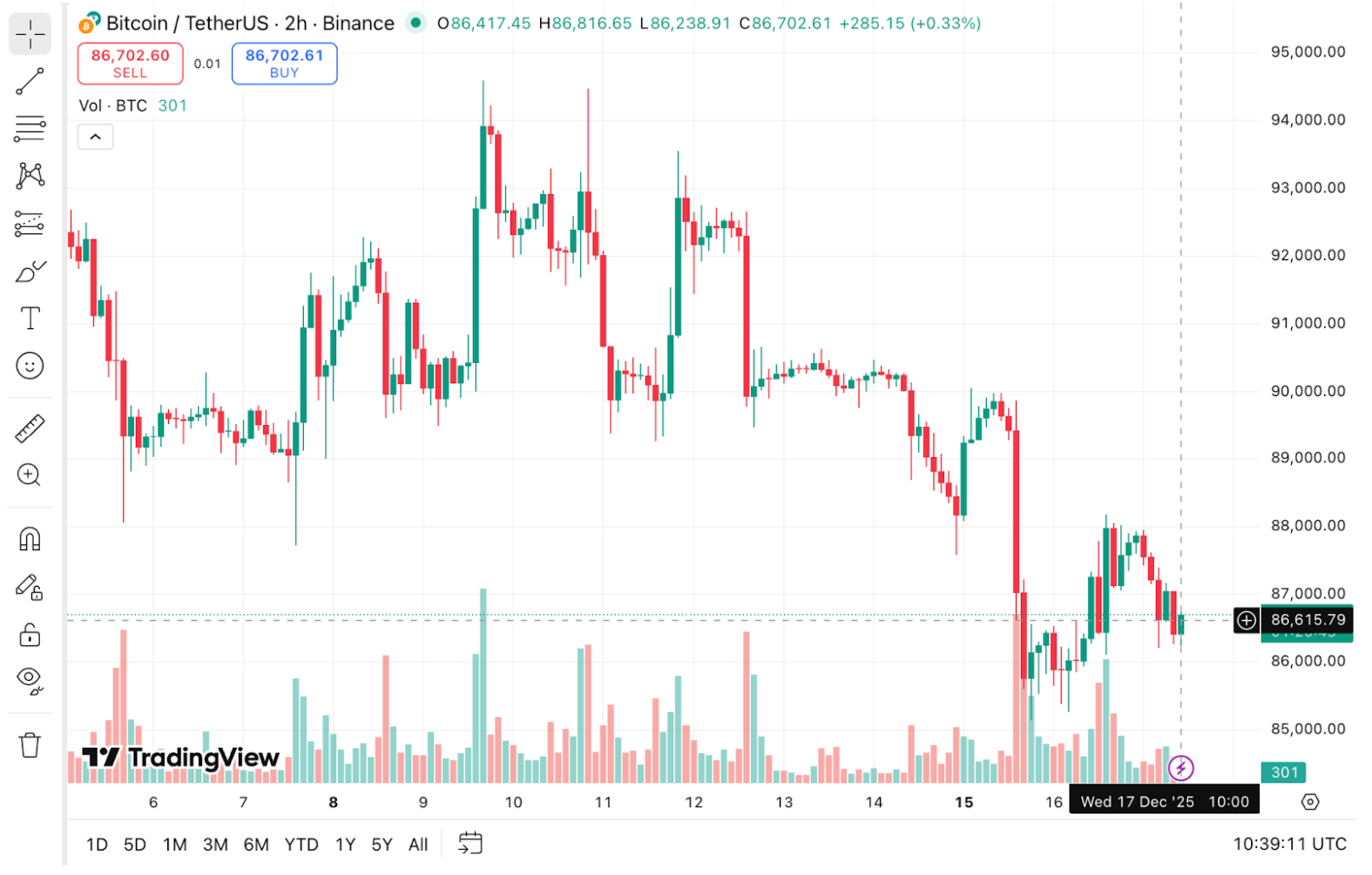
BTC USDT Chart. Source: TradingView
That combination tends to produce BTC/USDT liquidity that’s hard for other pairs to match. Tight spreads often attract more activity, and more activity often tightens spreads further. Another small but real effect is narrative: many altcoin moves get interpreted through “BTC strength vs USDT,” even if the trader never buys BTC directly.
BTC/USDT vs BTC/USD
At first glance, BTC/USDT vs BTC/USD looks like the same thing: Bitcoin priced in “dollars.” In everyday conversation, people often treat them as interchangeable, and for many quick checks, they roughly are.
The differences show up in the plumbing and in market conditions. BTC/USD uses actual fiat dollars on the back end, tied to banking rails and regional access rules, while BTC/USDT uses a stablecoin that moves on-chain and across exchanges more easily. That changes where liquidity concentrates and how fast funds can move.
Dimension | BTC/USDT | BTC/USD | What it means for the reader |
Quote asset type | Stablecoin (USDT) | Fiat currency (USD) | Both feel “dollar-like,” yet only one is actual bank money. |
Settlement path | Crypto rails (stablecoin transfers) | Banking rails + exchange balances | Transfers and access can differ by platform and jurisdiction. |
Typical access (global/regions) | Often widely available where stablecoins are supported | Strong in USD-friendly regions and regulated venues | Some traders find USDT pairs easier to access, others prefer fiat. |
Liquidity concentration | Often concentrated on crypto-native venues | Often concentrated on regulated fiat venues | Best price and depth can vary by venue. |
Banking dependency | Lower direct dependency | Higher direct dependency | Banking delays and limits matter more for BTC/USD. |
Common use cases | Trading, hedging into stable value, quick reallocation | Trading, fiat on/off ramps, reporting in USD | The “right” pair depends on the goal for that trade. |
Key risks | Stablecoin peg and issuer confidence risks | Banking and venue access risks | BTC/USDT is not identical to BTC/USD in stressed markets. |
A common misconception callout: BTC/USDT is not always the same as BTC/USD. In calm markets the difference may look tiny, yet in a fast sell-off, USDT demand and stablecoin pricing can shift, and the gap can widen for short periods.
BTC/USDT vs Other Pairs
BTC/USDT gets a lot of attention in the overall crypto ecosystem, yet it’s not the only “dollar-style” Bitcoin market. Traders also look at BTC/USDC and BTC/USD, plus many altcoin pairs like SOL/USDT that can behave very differently once liquidity dries up.
Here’s a practical way to think about a few common alternatives.
Pair | Liquidity | Stability | Use Case |
BTC/USDT | Very high on many venues | USDT aims to track USD, with occasional stress events | Main price reference, high activity, fast switching between BTC and stable value. |
BTC/USD | High on fiat-focused venues | USD is fiat; pricing depends on venue access | Fiat on/off ramp trading, reporting and accounting in actual dollars. |
BTC/USDC | Often strong, usually smaller than BTC/USDT on many venues | USDC aims to track USD | Similar to BTC/USDT, sometimes preferred where USDC is dominant. |
BTC/altcoin (example: BTC/ETH) | Varies a lot | Neither side is stable | Useful for relative-strength views, yet harder for beginners to track in “dollars.” |
One myth worth busting early: “USDT = USD exactly.” It’s designed to track the dollar, and it often trades close to $1, yet it can deviate under stress and it carries issuer and market-structure risks that pure fiat does not.
Altcoin pairs add another layer. If both assets swing at once, it can get confusing to tell whether a move came from Bitcoin strength, the altcoin weakening, or both. For newer traders, stablecoin-quoted pairs often feel clearer since the quote side is meant to stay near a steady value.
Risks and Strategies
BTC/USDT is popular, yet popularity does not remove risk. Before looking at tactics, it helps to know what can go wrong and what signals people commonly watch.
Risk Factors to Understand First
BTC volatility is the obvious one. Bitcoin can move quickly, and a “small” percentage swing can still mean a lot of money if position sizes are too large. Why it matters: stops can slip, emotions kick in, and fast markets punish unclear plans. What to watch: broader market news, sudden volume spikes, and whether price is moving with or against the overall crypto trend.
Stablecoin risk is quieter, yet real. USDT is meant to hold a peg, but confidence and liquidity can shift under pressure, and USDT has shown past deviations from $1 during extreme events. Why it matters: a trader might think they are parked in “cash,” yet the quote currency can wobble.
Execution and custody risks round out the list. Slippage and spreads can widen in fast markets, and transfers carry address and network risks. What to watch: order-book depth, fee schedules, network congestion, and any major news touching stablecoins or the venue used.
Strategy Ideas (Not Advice)
No strategy is “safe,” and outcomes vary. Still, a few patterns show up again and again in BTC/USDT discussions, and they’re worth understanding as educational examples.
Some people use DCA-style accumulation, buying small amounts of BTC at set intervals so entry timing matters less. Others adjust position size based on volatility, going smaller when swings grow and slightly larger when the market is calm. Range trading concepts are also common, where a trader looks for repeated bounces between support and resistance, then keeps risk tight when the range breaks.
Another approach is cross-venue price-checking. Prices can differ slightly across venues, so traders compare quotes before acting, especially during fast moves. SimpleSwap encourages users to understand fees, execution timing, and transfer details before acting.
A short planning checklist that many traders keep nearby:
Entry plan: What price area, and what confirms the entry?
Exit plan: Profit target, stop level, or time-based exit.
Max loss: A number set before the trade, not during it.
Sizing: Small enough that a bad trade stays manageable.
Fees and spreads: Check total cost, not just the headline price.
Whether or not you are planning on embarking on a BTC/USDT trading path, buying and swapping either one of the coins is possible on the SimpleSwap exchange platform. That’s how the process goes:
1. Open SimpleSwap and choose Crypto Exchange.

2. In You Send, pick your coin (for example, USDT). In You Get, select BTC.
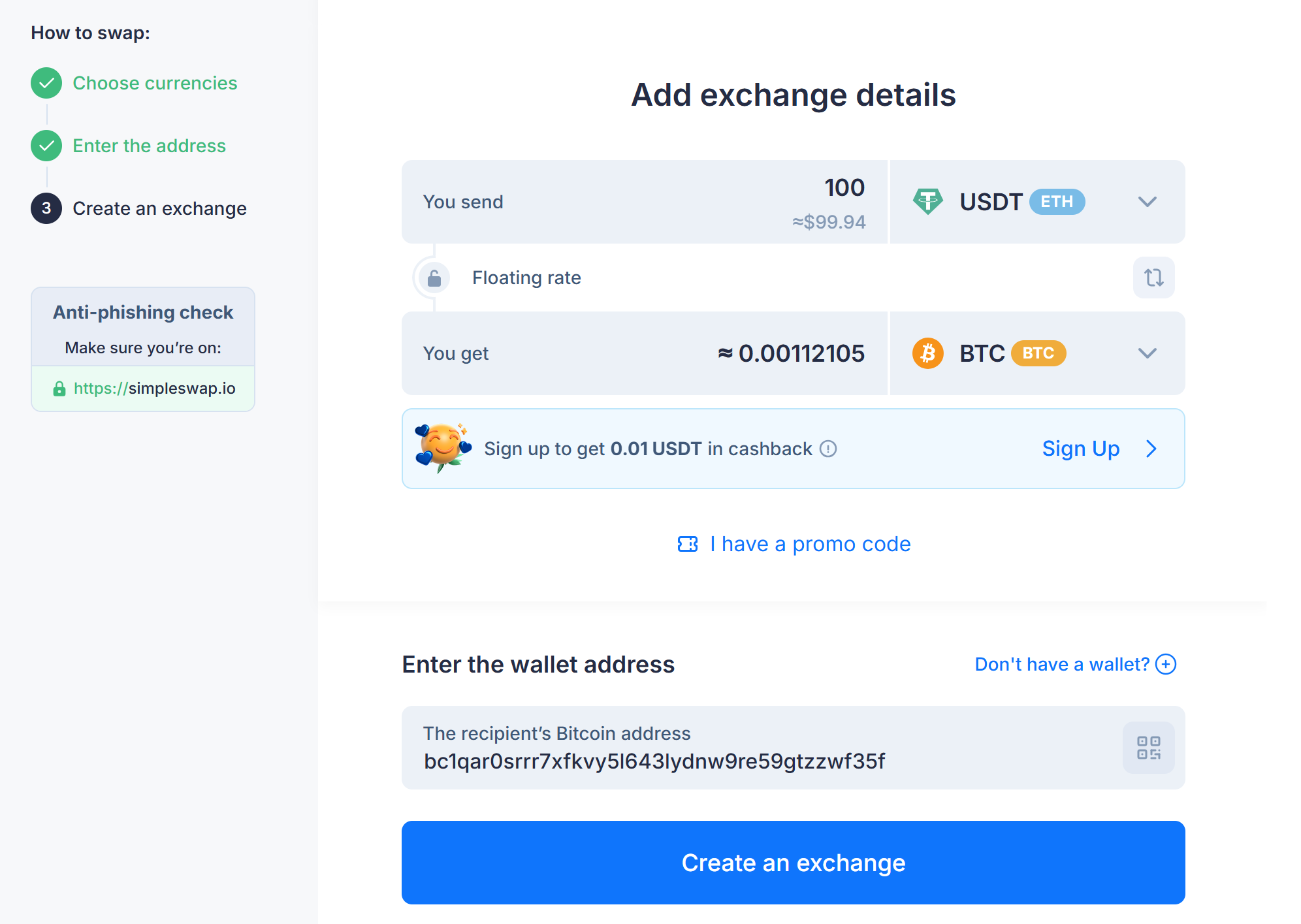
*The wallet address on the picture is provided for example purposes only, it is not a real one.
3. Click Exchange, paste your receiving address (so funds land where you’ll use them).
4. Confirm the rate and send your deposit.
5. Receive BTC (typically within minutes), no registration required.
Users can also use SimpleSwap to buy with crypto for fiat using debit or credit cards. On the coin pages users can also monitor the up-to-date prices and other key parameters.
Be sure to verify the ticker, chain, and the receiving address.
Round-Up
BTC/USDT recap: it’s Bitcoin priced in Tether, and it functions as a liquidity hub and a BTC price benchmark across much of crypto. The pair’s scale tends to attract more trading activity, which often supports tighter spreads and easier execution compared with thinner markets.
It also acts as a practical bridge between volatile BTC and a stable-value unit, which is why many traders watch it even when they trade other coins.
The article walked through what is BTC, what is USDT, and how crypto trading pairs turn those two assets into a live quote you can read in seconds. It also covered why BTC/USDT stands out in crypto trading volume 2025 discussions, how it differs from BTC/USD and other pairs, and what risk buckets matter most, from Bitcoin volatility to stablecoin peg stress and execution issues.
Strategy-wise, beginners and advanced traders often build routines around BTC/USDT’s depth, whether that’s simple periodic buying, volatility-aware sizing, or basic range ideas. Results can vary widely, and it’s smart to test assumptions, track outcomes, and keep risk limits clear.
Many readers find it helpful to monitor BTC/USDT as a core market indicator, then apply these concepts carefully and independently.
FAQ
What Is BTCUSDT?
BTC/USDT meaning is “the price of 1 Bitcoin, shown in Tether (USDT).” If a chart says BTC/USDT = 87,000, it means one BTC is trading for about 87,000 USDT at that moment. The quote updates constantly as orders hit the market, so the number can change second by second on active venues. It also helps to remember the pair format: BTC is what’s being priced, and USDT is the unit used to express that price.
Why is BTC/USDT More Popular than BTC/USD?
BTC/USDT often wins on convenience and market structure. Stablecoins move on crypto rails, so traders can shift between assets without waiting on bank transfers, and many exchanges list USDT pairs very broadly. Liquidity also tends to cluster where the crowd is, and the crowd frequently trades BTC against USDT, which can translate into tighter spreads. This does not mean BTC/USDT is always “better” than BTC/USD, it just means the crypto-native quote currency setup fits how many people trade day to day.
Is BTC/USDT Safe?
“Safe” depends on how risk is handled. BTC/USDT includes Bitcoin price volatility, plus stablecoin-specific risks tied to how USDT holds its peg and how the market values it under stress. Platform and execution factors matter too, like spreads widening during sharp moves and transfer mistakes if funds are sent to the wrong address or network. Basic risk hygiene helps: start small, avoid oversized positions, spread exposure instead of betting everything on one idea, and stay alert to major news that can affect BTC or stablecoins.
How Does a Beginner Start Trading BTC/USDT?
A beginner can start with a simple flow. First, practice reading the quote: it’s how many USDT equal 1 BTC right now. Next, pick a small amount that won’t sting if the market moves against it, then check the full cost, including fees and the spread. After that, place a basic order, track what happened, and write down why the trade was opened and where it should be closed. Over time, that habit builds clarity, which matters more than speed in the early stage.